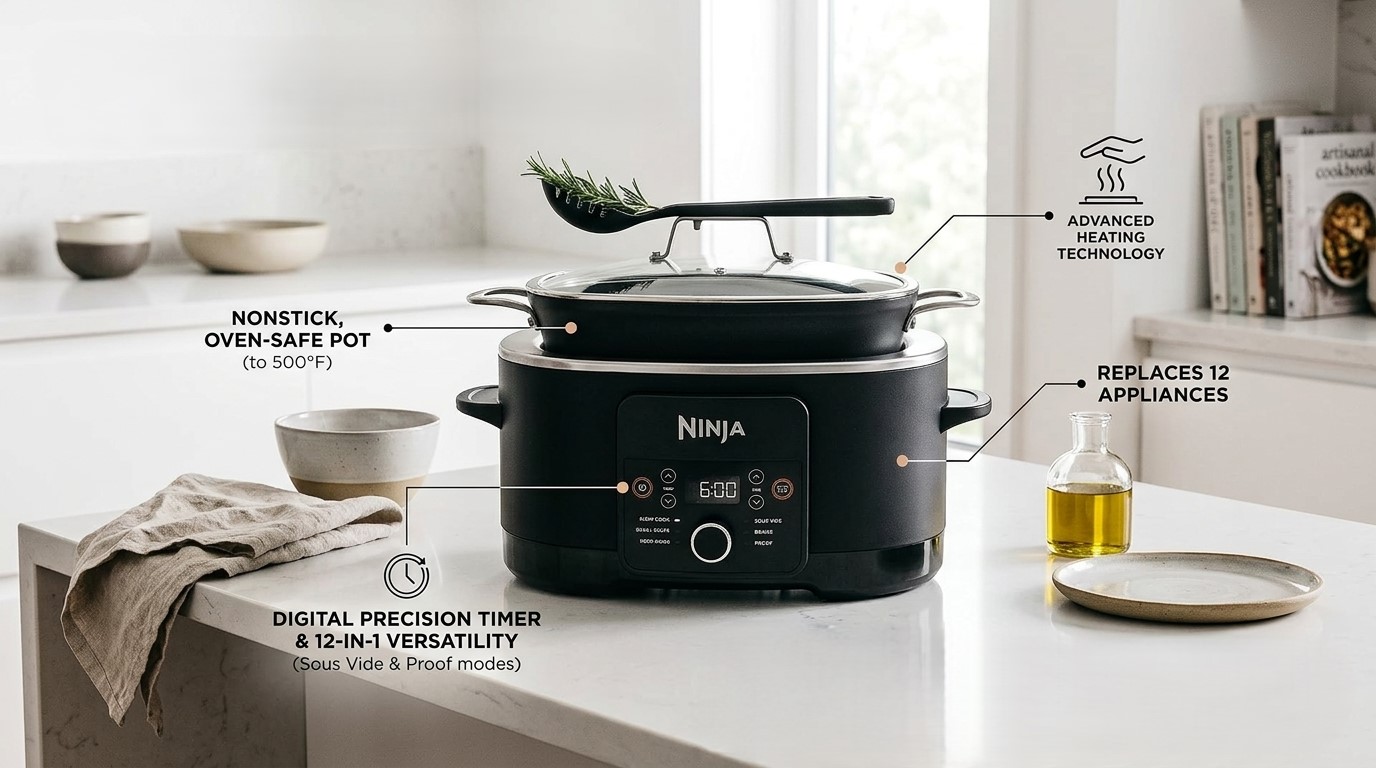
Kitchen counters only have so much real estate, and anyone who has tried to fit a slow cooker, a Dutch oven, a bread proofing box, and a sous vide immersion circulator into the same cabinet knows the struggle. Multi-function cooking appliances exist precisely to solve that problem, and the Ninja PossibleCooker PLUS 12-in-1 (model MC1010) is one of the more recent entries into that category. It’s built around a large nonstick pot, a base unit with several cooking modes, and a design that’s meant to move from stovetop-style searing to slow cooking to a hot oven, and then straight to the table.
This article walks through what the Ninja PossibleCooker PLUS actually does, how people commonly put it to use, who tends to get the most value from an appliance like this, and a few practical points worth thinking about before adding it to a kitchen. It’s written as an informational guide rather than a sales pitch, so you’ll find balanced descriptions of the features alongside honest considerations, not just a list of selling points.
What Is the Ninja PossibleCooker PLUS 12-in-1?
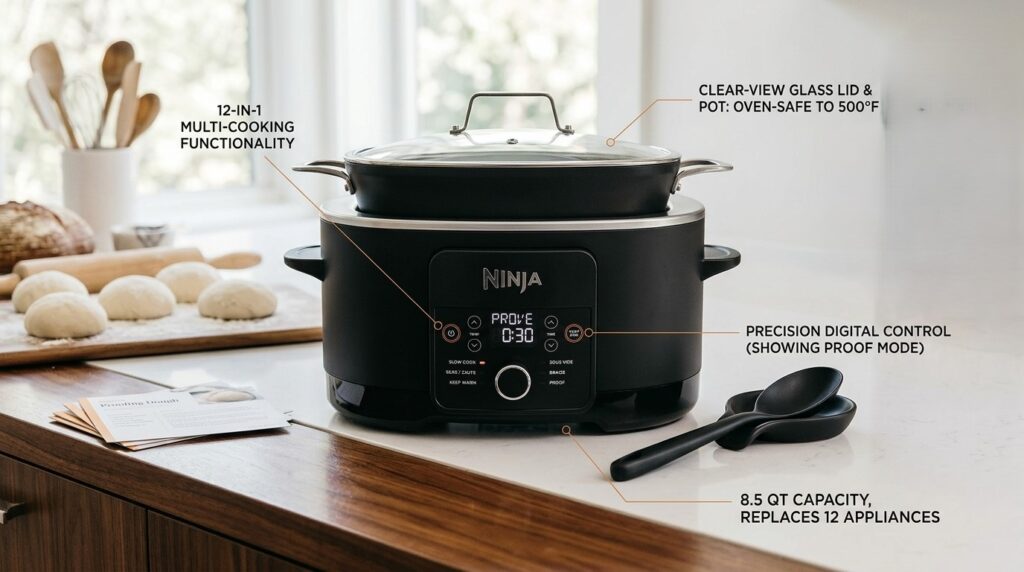
The MC1010 is an 8.5-quart multi-cooker from Ninja’s PossibleCooker lineup. The “12-in-1” branding refers to the range of separate cooking tools and appliances it’s designed to stand in for — items like a slow cooker, a sauté pan, a cast iron skillet, a saucier, a saucepan, a stockpot, a Dutch oven, a roasting pan, a bread maker, a food warmer, a nonstick pot, and a serving utensil. Rather than housing twelve individual mechanisms, the appliance consolidates these roles into one countertop unit with six distinct cooking functions: Slow Cook, Sear/Sauté, Keep Warm, Sous Vide, Braise, and Proof.
At the center of the design is Ninja’s Triple Fusion Heat technology, which combines heat from the bottom, the sides, and steam within the pot, rather than relying on a single heating element the way a traditional slow cooker does. According to Ninja, this combination allows food to cook up to 30% faster than a conventional oven, a figure the company says was measured using 6-pound chickens as a test case — worth keeping in mind, since actual results will vary depending on the recipe, the quantity of food, and the cooking method chosen.
Key Features
8.5-Quart Nonstick Cooking Pot
The removable pot is the centerpiece of the unit, offering enough volume for larger-format cooking — think family-sized stews, big batches of chili, or a whole cut of meat like a brisket or pork shoulder. The interior is coated with a nonstick surface that Ninja states is manufactured without PFOA, cadmium, or lead. Because the pot detaches from the base, it can be carried to the stovetop area, table, or oven independently of the electrical components.
Six Cooking Functions in One Base
Rather than a single “set it and forget it” mode, the base unit offers:
- Slow Cook — for long, low-temperature cooking of stews, roasts, and braises
- Sear/Sauté — using the bottom heating element to brown proteins or soften vegetables directly in the pot
- Keep Warm — to hold finished food at serving temperature
- Sous Vide — for precise, water-bath style temperature-controlled cooking
- Braise — combining moist and dry heat for tougher cuts of meat
- Proof — a gentle, warm setting designed to help yeasted doughs rise
Having sear and sauté built into the same vessel used for slow cooking is one of the more practical aspects of this style of appliance, since it removes the extra step (and extra pan to wash) that’s traditionally required to brown meat before adding it to a slow cooker.
Oven-Safe Pot, Up to 500°F
The cooking pot itself is rated as oven-safe up to 500°F, which allows a dish to be finished under higher, drier heat after being braised or slow-cooked — useful for getting a browned top on a casserole or a crisp finish on roasted vegetables. It’s worth being precise here: it’s the removable pot that carries the oven-safe rating, not the electric base unit, which should never be placed inside a conventional oven. This “cooker-to-oven-to-table” workflow is one of the more distinctive aspects of the PossibleCooker line compared to a standard single-function slow cooker.
Glass Lid and Integrated Utensil
The unit comes with a glass lid, which allows food to be monitored without lifting it and releasing heat, along with a multi-functional detachable spoon-ladle utensil. The utensil is designed to double as a ladle and a pasta-style fork, and it has a small rest built into the lid handle so it doesn’t need to be set directly on the counter between uses.
What’s Included in the Box
The standard package typically includes the 8.5-quart cooking pot, the PossibleCooker base unit, the integrated detachable spoon-ladle, the glass cooking lid, and a recipe guide curated by Ninja’s culinary team to help new owners get oriented with the different cooking modes.
Cleaning and Care
The glass lid and the utensil are described as dishwasher-safe, while the manufacturer recommends hand-washing the nonstick pot to help extend the life of its coating over repeated use. This is a fairly standard recommendation for nonstick cookware in general, since dishwasher detergents and high heat cycles can gradually wear down nonstick surfaces faster than hand washing would.
How It Can Be Used
Because the appliance spans six distinct functions, it lends itself to a fairly wide range of cooking styles. Here’s a breakdown of practical ways people typically use a cooker like this one.
Everyday slow cooking. The most familiar use case is exactly what you’d expect from a traditional slow cooker: loading the pot with a stew, chili, pulled pork, or pot roast in the morning and returning to a finished meal later in the day. The larger 8.5-quart capacity means it can comfortably handle bigger batches — Ninja notes the pot can accommodate enough chili for around 20 servings, roughly 9 pounds of spaghetti and meatballs, or enough pulled pork for about 30 sliders, which makes it a reasonable option for entertaining or meal-prepping for the week ahead.
Browning before braising. Since the sear/sauté function uses the same bottom heating element the pot sits on, ingredients like stew meat, aromatics, or ground beef can be browned directly in the pot before switching over to a slow-cook or braise setting. This is one of the more time-saving aspects of an all-in-one cooker, since it avoids dirtying a separate skillet just to build flavor before slow cooking.
Sous vide cooking without a separate circulator. The Sous Vide setting allows the pot to function as a temperature-controlled water bath, useful for cooking proteins like chicken breast, steak, or eggs to a consistent internal doneness. This can be a helpful entry point for people who are curious about sous vide cooking but don’t want to buy a dedicated immersion circulator and a separate vessel just to try it out.
Proofing bread and pizza dough. The Proof setting provides a warm, controlled environment that can help speed up the rise time for yeasted doughs, which is particularly useful in colder kitchens where dough might otherwise take much longer to proof at ambient room temperature.
Braising tougher cuts. Short ribs, pork shoulder, and other cuts that benefit from low, moist heat over an extended period can go through the braise function, which is designed to combine direct heat with the moisture retained under the lid.
Finishing in the oven. Because the pot itself is oven-safe to 500°F, a dish that’s been slow-cooked or braised can be moved into a preheated oven briefly to develop a browned or crisped top — something a standard slow cooker insert typically can’t do, since most ceramic crocks aren’t rated for that kind of direct, high-heat oven use.
Serving straight from the pot. The cooker-to-table design means the same vessel used to cook the meal can also go to the table for serving, which cuts down on the number of dishes involved in a typical meal — one less serving bowl to wash, and one less transfer that risks spilling a hot dish.
Who It May Be Suitable For
An appliance like this tends to make the most sense for a few particular kinds of cooks and households:
- People who batch cook or meal prep. The 8.5-quart capacity is generously sized for cooking multiple servings at once, whether that’s for a family, for freezing leftovers, or for prepping lunches for the week.
- Those who regularly host or cook for groups. The larger capacity and “keep warm” function make it a reasonable fit for potlucks, holiday gatherings, or casual entertaining where food needs to stay at serving temperature for a while.
- Cooks who want to consolidate kitchen tools. For smaller kitchens or apartments where storage space is limited, replacing several single-purpose gadgets with one multi-function unit can meaningfully reduce cabinet clutter.
- People curious about sous vide or bread proofing but not ready to invest in dedicated equipment. Rather than buying a standalone immersion circulator or a proofing box, this cooker offers a way to try both techniques using equipment already on the counter.
- Anyone who values a one-pot cooking workflow. Being able to sear, braise, slow cook, and finish in the oven using the same vessel appeals to people who prefer fewer dishes and fewer transfers between pots and pans.
On the other hand, it may be less of a fit for people who live alone or cook only for one or two people regularly, since the 8.5-quart pot is on the larger side and may feel oversized for small portions. It’s also not a substitute for a dedicated pressure cooker, since pressure cooking isn’t one of the six functions built into this particular model.
Important Things to Consider
Before deciding whether this kind of appliance fits your kitchen, a few practical points are worth thinking through:
Size and storage. An 8.5-quart pot plus a base unit takes up meaningfully more counter and cabinet space than a compact slow cooker or a single sauté pan. If kitchen storage is already tight, it’s worth measuring available space before assuming it will tuck neatly into an existing cabinet.
Only the pot is oven-safe — not the base. It bears repeating that the electric base unit is not designed to go into an oven. Only the detachable cooking pot carries the 500°F oven-safe rating, so it’s important to separate the two components before using the oven-finishing feature.
Hand-washing is recommended for the pot. While the lid and utensil are dishwasher-safe, the nonstick pot itself is generally recommended for hand washing to preserve the coating over time. This is a small extra step compared to appliances where every component can go straight into the dishwasher.
Sous vide performance differs from a dedicated circulator. Because the pot functions as a fixed vessel rather than a clip-on immersion circulator, it may not offer quite the same water circulation or precision that some standalone sous vide devices are built specifically to provide. It can still be a useful and convenient way to try the technique, but it’s a different mechanism than a purpose-built circulator.
The “30% faster” comparison is based on a specific test. Ninja’s claim about cooking speed compared to a conventional oven is based on internal testing using 6-pound chickens, according to the company. Actual time savings will vary depending on what’s being cooked, how much food is in the pot, and which function is being used, so it’s reasonable to treat this figure as a general reference point rather than a guarantee for every recipe.
Some accessories are sold separately. Add-ons such as steaming or roasting racks compatible with this model are generally available as separate purchases rather than included in the standard box, which is worth knowing if you’re planning to use steaming functions regularly.
Learning curve. With six different cooking functions built into one unit, there’s a bit of a learning period involved in understanding which setting is appropriate for which dish, especially for anyone who hasn’t used a multi-cooker before. The included recipe guide is intended to help bridge that gap.
How This Type of Appliance Compares to Other Cooking Equipment Categories
Rather than comparing this specific model against other named products, it’s useful to think about how this general category of appliance — the all-in-one, multi-function cooker — stacks up against more traditional, single-purpose kitchen equipment.
Versus a traditional slow cooker. A basic slow cooker is typically limited to low-and-slow cooking with a single heating element and doesn’t usually support searing, oven use, or sous vide. A multi-function cooker like this one trades some of that simplicity for added versatility, at the cost of a steeper learning curve and, generally, a larger footprint.
Versus a standalone sous vide immersion circulator. Dedicated sous vide circulators are built specifically around precise water circulation and temperature control, often clipping onto any pot a person already owns. A built-in sous vide function on a multi-cooker offers convenience and one less gadget to store, but it may not replicate the exact circulation performance of equipment designed solely for that purpose.
Versus a cast iron Dutch oven. Cast iron Dutch ovens are prized for heat retention and can go from stovetop to oven to table, similar in spirit to what this appliance offers. However, cast iron requires its own seasoning and care routine, tends to be heavier, and doesn’t offer programmable functions like slow cooking or sous vide — it relies entirely on the cook’s active attention and the heat source underneath it.
Versus a bread maker or dedicated proofing box. Dedicated bread machines automate mixing, kneading, and baking within one enclosed unit, which is a different process than the proofing-only function offered here. A multi-cooker’s proof setting is more of a supporting tool for dough that’s been mixed and shaped separately, rather than a full bread-making replacement.
Versus general electric pressure cookers. Many popular multi-cookers on the market emphasize pressure cooking as a core function for speeding up cook times. This particular model doesn’t include a pressure cooking mode, so anyone specifically looking to replace a pressure cooker would want to confirm that a given multi-cooker actually includes that function before assuming it does.
In general, appliances in this “combination cooker” category are built around convenience, versatility, and reduced kitchen clutter rather than trying to out-perform single-purpose tools at their one specific job. Whether that trade-off makes sense comes down to how much a household values flexibility and counter-space savings versus the specialized performance of dedicated equipment.
Frequently Asked Questions
Why is it called “12-in-1” if there are only six cooking functions listed? The “12-in-1” language refers to the number of separate kitchen tools and appliances the cooker is designed to replace — including things like a slow cooker, sauté pan, cast iron skillet, saucier, saucepan, stockpot, Dutch oven, roasting pan, bread maker, food warmer, nonstick pot, and utensil — rather than the number of distinct electronic cooking modes, which is six (Slow Cook, Sear/Sauté, Keep Warm, Sous Vide, Braise, and Proof).
Is the entire appliance oven-safe? No. Only the removable cooking pot is rated as oven-safe, up to 500°F. The electric base unit should not be placed in an oven under any circumstances.
Can the cooking pot go in the dishwasher? The glass lid and the integrated utensil are described as dishwasher-safe, but hand-washing the nonstick pot is recommended to help preserve the nonstick coating over time.
How does the sous vide function work on this cooker? The Sous Vide setting allows the pot to act as a temperature-controlled water bath, which can be used to cook proteins like chicken, steak, or eggs to a consistent internal temperature. It functions differently from a clip-on immersion circulator, since the heating happens within the fixed pot rather than through a separate circulating device.
Can dough actually be proofed inside the pot, or does it need a separate container? The Proof function is designed to create a warm environment inside the cooker that can help speed up dough rising. Many people place a bowl of dough inside the pot for proofing rather than putting the dough directly against the nonstick surface, though usage can vary depending on the recipe and personal preference.
Is the 8.5-quart size too large for a small household? It can be, depending on typical portion needs. The capacity is generally geared toward larger families, batch cooking, or entertaining, so a smaller household cooking for one or two people might find the pot larger than what’s needed for everyday meals, even though it can still be used at partial capacity.
Does this replace a pressure cooker? No. Pressure cooking is not one of the six functions included on this model, so it isn’t a direct substitute for a dedicated electric pressure cooker.
What comes in the box? The standard package generally includes the 8.5-quart cooking pot, the base unit, the glass lid, the integrated detachable spoon-ladle utensil, and a recipe guide. Additional accessories, such as steaming racks, are typically sold separately.
What does “Triple Fusion Heat” actually mean? It refers to the combination of three heat sources working together inside the pot — heat from the bottom, heat from the sides, and steam — rather than a single bottom-mounted heating element like a conventional slow cooker uses. Ninja states this combination allows for faster cooking compared to a conventional oven, based on internal testing using 6-pound chickens.
Final Thoughts
The Ninja PossibleCooker PLUS 12-in-1 is best understood as a consolidation tool — a way to fold several separate pieces of cookware and small appliances into a single countertop unit that can sear, slow cook, braise, proof dough, run a sous vide bath, and finish a dish in the oven before it heads to the table. For households that batch cook, entertain regularly, or simply want to free up cabinet space without giving up cooking versatility, that combination of functions can be genuinely useful. At the same time, it’s worth going in with realistic expectations: the pot is large, hand-washing is recommended, only the pot (not the base) is oven-safe, and a built-in sous vide or proofing function won’t necessarily match the precision of equipment built solely for those tasks. Weighing those trade-offs against your own kitchen habits is the best way to judge whether this style of multi-cooker earns a permanent spot on the counter.