Introduction
Not every meal needs a six-quart pot simmering away on the counter. Sometimes it’s just you and one other person, a batch of queso for a small gathering, or a side dish that doesn’t warrant tying up your full-size slow cooker for eight hours. That’s the gap the Crock-Pot 2-Quart Manual Slow Cooker is designed to fill. It’s a compact, no-frills appliance built around a simple idea: low-and-slow cooking shouldn’t require a large footprint or a complicated control panel when you’re only feeding a couple of people.
This article walks through what the appliance actually offers, how people tend to use it in real kitchens, who it tends to suit best, and a few practical considerations worth thinking about before adding one to your countertop lineup. Along the way, we’ll also look at how small manual slow cookers compare to other general categories of slow cookers, so you can decide whether this size and style fits the way you cook. Nothing here is meant as a sales pitch — the goal is simply to give you a clear, balanced picture so you can make an informed decision for your own kitchen.
Key Features
Small kitchen appliances live or die on a handful of practical details, so let’s break down what defines this particular slow cooker.
Compact 2-Quart Capacity
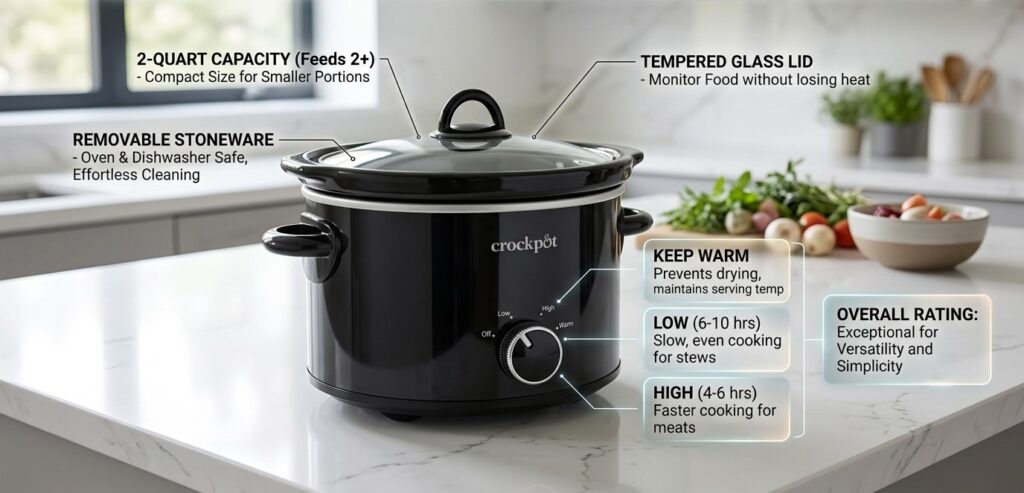
The defining feature is right in the name: a 2-quart stoneware insert. That’s roughly enough to prepare a modest main dish for two people, a warm dip for a small get-together, or a single side dish like mashed potatoes or baked beans without dedicating a large appliance to the job. It’s not built for feeding a crowd or batch-cooking for the week — it’s meant for smaller portions where a full-size cooker would be overkill.
Manual Dial Controls
Unlike programmable slow cookers that come with digital timers, delayed-start functions, or app connectivity, this model uses a simple manual dial. You choose a setting and let the appliance do its work — there’s no screen to program and no countdown to monitor. For people who find digital interfaces unnecessary for a small appliance like this, the manual dial keeps things straightforward. The tradeoff, of course, is that it doesn’t automatically switch to a “keep warm” mode on its own schedule the way some programmable units do; you’re responsible for keeping an eye on cook time.
Three Heat Settings
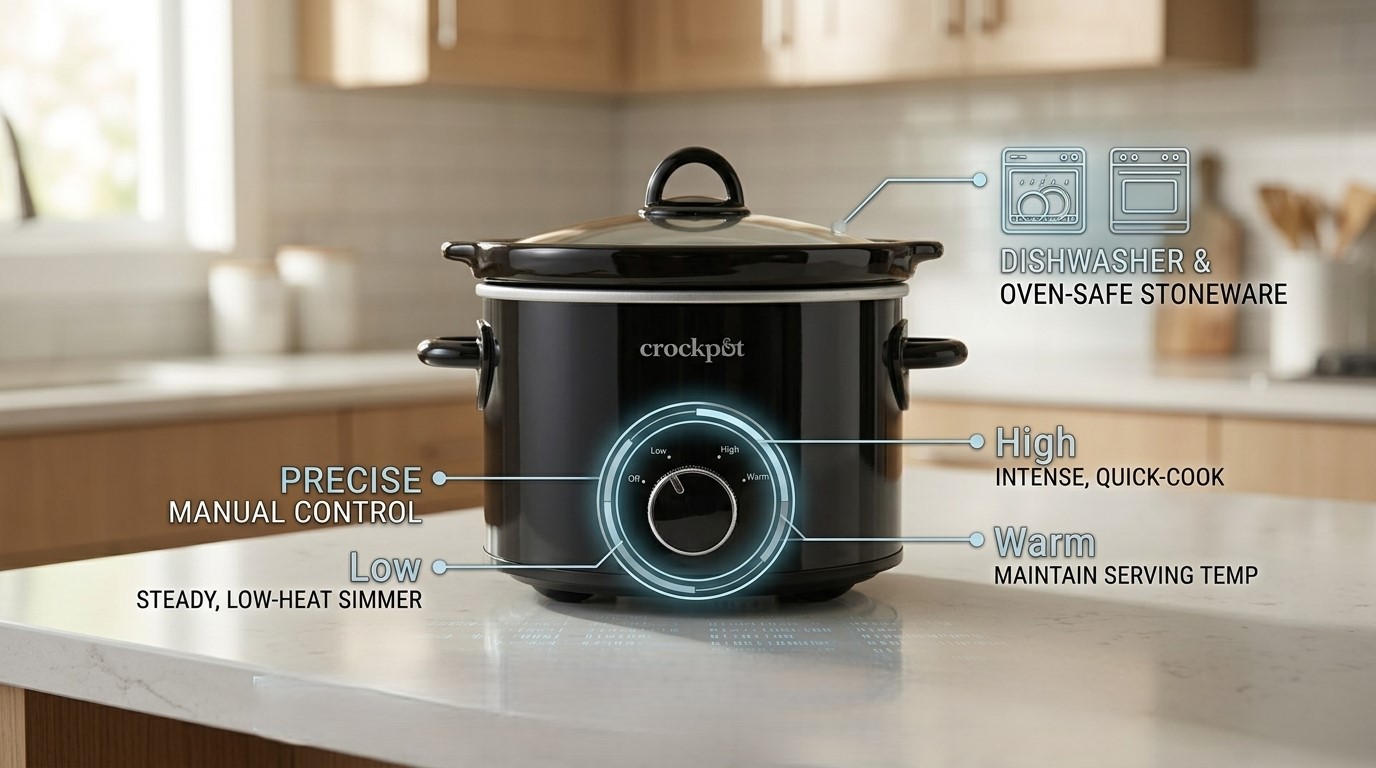
The dial typically includes High, Low, and Warm settings, giving a bit of flexibility depending on what you’re preparing and how much time you have. High is generally suited to shorter cooking sessions, Low is designed for extended, gentler cooking (the kind slow cookers are known for), and Warm is meant to hold already-cooked food at serving temperature rather than continue cooking it — useful if you’re bringing a dip to a party and want it to stay at a good temperature without overcooking.
Removable, Oven-Safe Stoneware
The stoneware insert lifts out of the heating base, which serves two purposes. First, it makes serving more convenient — you can bring the stoneware straight to the table rather than transferring food to a separate serving dish. Second, because the stoneware itself is oven-safe (commonly rated up to around 400°F, though it’s worth double-checking the specific care instructions that come with your unit), it opens up the option of finishing a dish under higher heat, such as browning a cheese topping, before serving.
Dishwasher-Safe Components
Both the stoneware insert and the lid are generally dishwasher-safe, which cuts down on the hand-washing that some kitchen appliances demand. The heating base itself, like most slow cooker bases, should never be submerged in water — only the insert and lid go in the dishwasher or sink.
Compact Footprint and Simple Design
At roughly the size of a large mixing bowl, this slow cooker doesn’t take up much counter or cabinet space. Its rounded shape and black finish are meant to blend into most kitchen aesthetics without standing out awkwardly, and its light weight (typically a few pounds) makes it easy to move, store in a cabinet, or transport to a friend’s house for a potluck.
How It Can Be Used
A small manual slow cooker is more versatile than its size might suggest. Here are some of the more common ways people put a 2-quart model to use.
Small-Batch Main Dishes
For a household of one or two people, a full-size slow cooker often means eating the same dish for days afterward — which isn’t a problem for some, but not what everyone wants on a given week. A 2-quart cooker allows for a proportionally smaller batch of chili, soup, pulled chicken, or a simple braised dish, without the math (or the storage containers) that come with scaling a large-format recipe down.
Dips and Party Appetizers
This is one of the categories the product is explicitly marketed toward, and it’s a genuinely practical use case. Warm dips — queso, spinach-artichoke, buffalo chicken, or a simple melted cheese and salsa combination — benefit from a low, steady heat source that keeps them at serving temperature throughout a gathering without scorching or drying out on a stovetop burner. Because the stoneware is small, it also avoids the “half-empty pot” look that a large slow cooker gets when it’s holding a dip meant for a dozen people, not fifty.
Side Dishes for a Larger Meal
When the oven and stovetop are already occupied with a main dish, a small slow cooker can quietly handle a side — mashed potatoes, glazed carrots, baked beans, or stuffing — freeing up burner space and one less thing to actively monitor. This is a common use during holidays or larger meals where kitchen real estate is at a premium, even if the meal itself isn’t small.
Reheating and Holding Food Warm
The Warm setting is useful beyond its original cooking purpose. Leftovers, soup, or gravy can be gently reheated and then held at a stable serving temperature, which is handy for casual entertaining where guests serve themselves over the course of an hour or two rather than sitting down all at once.
Simple Desserts
Small slow cookers are also used for simple desserts in modest portions — things like a small batch of bread pudding, stewed fruit, or a warm chocolate dessert. The gentle, even heat works similarly to how it handles savory dishes, and the compact size fits the smaller portions desserts often call for.
Beverages
Some people use small slow cookers to keep mulled cider, spiced wine, or hot cocoa warm during a gathering, using the Warm setting to hold the beverage at a comfortable serving temperature for guests to pour themselves throughout an event.
Who It May Be Suitable For
No single kitchen appliance suits every household, and a 2-quart manual slow cooker is a good example of a product built with a fairly specific set of users in mind.
People cooking for one or two. If your household rarely needs to feed more than a couple of people at a time, a large slow cooker can feel disproportionate to the task. This smaller format is generally a better match for everyday portion sizes.
People who entertain in small groups. If you regularly host a few friends for game night or a casual get-together and want a warm dip or appetizer on hand, this size tends to fit that scale of entertaining better than a large-format cooker would.
People who prefer simple controls. Anyone who finds digital touchscreens or programmable timers unnecessary for a small appliance may appreciate the straightforward dial. There’s a genuine appeal in an appliance you can operate without reading a manual.
People with limited kitchen storage. Apartment dwellers, dorm residents, or anyone with limited cabinet space may find the compact size easier to store than a bulkier six- or seven-quart model.
People looking for a secondary or specialty appliance. Some households already own a larger slow cooker for family meals and are looking for a smaller companion unit specifically for dips, sides, or solo meals — rather than replacing their main cooker altogether.
On the other hand, this product is probably not the right fit for larger families, anyone who regularly meal-preps in bulk, or anyone who specifically wants programmable or delayed-start functionality, since the manual controls don’t offer that kind of automation.
Important Things to Consider
Before adding any small appliance to your kitchen, it helps to think through a few practical realities.
Capacity Is Genuinely Small
It’s worth taking the “2-quart” label seriously rather than assuming it will comfortably stretch to feed more people than intended. Slow cooker manufacturers generally recommend filling the stoneware somewhere between half and three-quarters full for best cooking results, which means the realistic usable capacity is somewhat less than the full 2 quarts. This is worth keeping in mind if you’re planning a specific recipe rather than a flexible one — measuring out your ingredients ahead of time can help you gauge whether they’ll fit comfortably.
No Digital Timer or Auto Shut-Off
Because the controls are manual, the appliance won’t automatically switch itself off or shift to a warm setting once a cook cycle is “done” in the way a programmable model might. This means a bit more attention to your own timing, particularly for dishes cooking on the High setting, which generally require closer monitoring than a long, slow Low-setting cook.
Glass Lid Care
Slow cooker lids, including this one, are typically made of tempered glass, which is durable under normal use but can be vulnerable to sudden temperature changes or impacts — for instance, running a hot lid under cold water, or setting a cold lid onto a very hot base. Handling the lid the same way you would any glass cookware (gradual temperature changes, careful stacking, avoiding drops) will help it hold up over time.
The Base Isn’t Submersible
Like virtually all slow cookers, the heating base that houses the electrical components isn’t designed to be submerged in water or placed in the dishwasher — only the stoneware insert and glass lid are. Wiping the base down with a damp cloth after it’s cooled is the general approach.
It’s a Single-Purpose Appliance
A manual slow cooker of this size does one thing: cooks and holds food at low, steady heat. It doesn’t sauté, pressure cook, or offer multiple cooking modes the way some multi-function countertop appliances do. If you’re looking for an all-in-one device, this wouldn’t be it — but if you specifically want a dedicated, simple slow cooker, that single-purpose design is generally seen as a feature rather than a limitation.
Countertop Space, However Small
Even a compact appliance still needs a permanent or semi-permanent spot if you plan to use it often. It’s worth thinking about where it will live — a cabinet shelf, a pantry, or a spot on the counter — before deciding how frequently you’re likely to reach for it.
Comparing General Categories of Slow Cookers
Rather than comparing this specific model to any particular competing product, it’s more useful to think about the broader categories of slow cookers on the market and how a small manual unit like this one fits among them.
Small manual slow cookers (around 1.5–3 quarts). These are designed for individuals, couples, or small households, and are typically used for dips, sides, and modest single-serving meals. Controls are usually simple dials with a small number of heat settings. The tradeoff for the compact size and simplicity is limited capacity — these aren’t meant for large batches or leftovers that need to last a family a full week.
Mid-size slow cookers (around 4–6 quarts). This is generally considered the most common “everyday” size for a household of three to five people. Mid-size units often include more features, such as programmable timers, and are versatile enough for everything from weeknight dinners to holiday side dishes, though they take up noticeably more counter and storage space than a 2-quart model.
Large slow cookers (7 quarts and up). These are built for bigger households, batch cooking, and meal prep, or for holiday cooking where a large cut of meat or a big batch of soup is on the menu. They often include more advanced digital controls, multiple probes, or locking lids for transport. Their size, however, makes them impractical for small, everyday meals or for households that don’t regularly cook in bulk.
Multi-cookers with a slow cook function. Some appliances combine slow cooking with pressure cooking, sautéing, and other functions in a single unit. These offer more versatility but come with a steeper learning curve and a higher price point in general, and the slow-cook function is often just one of several features rather than the appliance’s central purpose.
Positioned against these categories, a 2-quart manual slow cooker occupies a clear niche: it prioritizes simplicity and a small footprint over capacity or advanced functionality. It’s not meant to compete with mid-size or large cookers on volume, and it’s not trying to be a multi-function appliance — it’s built for a specific, smaller-scale use case, and how well it fits your needs really comes down to whether that use case matches your household.
Frequently Asked Questions
How many people can this slow cooker realistically serve? Generally speaking, a 2-quart slow cooker is suited to two people for a main meal, or a slightly larger group if it’s being used for a dip, side dish, or appetizer portion rather than a full plate.
Can I use it for recipes designed for larger slow cookers? Recipes written for a 4-quart or larger cooker usually won’t fit as-is. You’d generally need to scale the ingredient quantities down significantly, and cooking times may also need adjusting since a smaller volume of food often heats through faster than a large batch.
Is the stoneware insert really oven-safe? The removable stoneware is generally rated as oven-safe up to a specific temperature (commonly cited around 400°F for this type of insert), which allows for finishing a dish under the broiler or in the oven after slow cooking. It’s a good idea to confirm the exact temperature rating and any care instructions included with your specific unit before using it in the oven.
Can the whole unit go in the dishwasher? Only the stoneware insert and the glass lid are dishwasher-safe. The electrical base should never be submerged or placed in the dishwasher — it’s typically cleaned by wiping down the exterior with a damp cloth once it has cooled completely.
Does it have a programmable timer or auto shut-off? No. This is a manual slow cooker, meaning you select a heat setting yourself and are responsible for monitoring cook time, rather than relying on a digital timer or automatic shift to a warm setting.
What’s the difference between the High, Low, and Warm settings? High settings are generally used for shorter cooking sessions, Low is intended for longer, gentler cooking (which is the traditional slow-cooker approach), and Warm is meant to hold already-cooked food at a safe serving temperature without continuing to cook it further.
Is this a good option as a first slow cooker, or better as a second unit? That depends on your household size and cooking habits. For someone cooking primarily for one or two people, it can work well as a primary appliance. For larger households, it tends to work better as a secondary unit for dips, sides, or smaller portions alongside a full-size cooker.
How much counter or storage space does it need? Its dimensions are roughly comparable to a large mixing bowl or a standard stockpot, so it generally fits on a single cabinet shelf or in a corner of the counter without much trouble.
Conclusion
A slow cooker doesn’t have to be large to be useful — sometimes the more practical choice is the one sized to match what you’re actually cooking. The Crock-Pot 2-Quart Manual Slow Cooker is built around that idea: a compact stoneware insert, straightforward dial controls, and dishwasher-safe parts, aimed squarely at small meals, dips, and side dishes rather than big-batch cooking. It won’t replace a full-size cooker for a large family, and it doesn’t offer the programmable features some larger models include, but for the right household — someone cooking for one or two, or looking for a dedicated appliance for entertaining-sized dips and sides — that simplicity can be exactly the point.