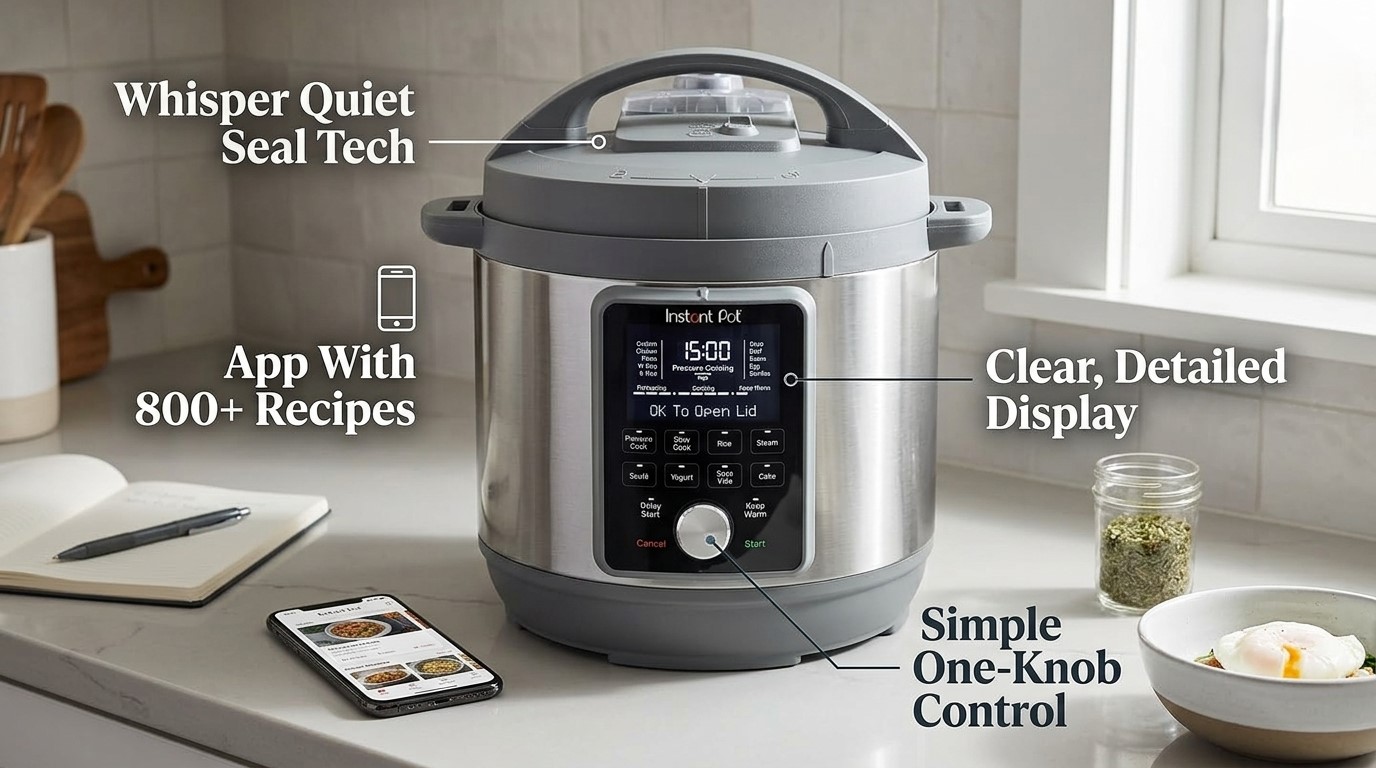
Walk into almost any kitchenware section, online or off, and you’ll notice that countertop cooking appliances have quietly consolidated over the past decade. Instead of a slow cooker in one cabinet, a rice cooker in another, and a yogurt incubator gathering dust somewhere in the back, many households have shifted toward a single multi-function device that handles several of these jobs at once. The Instant Pot Duo Plus, in its 8-quart Whisper Quiet configuration, is one of the more established options in that category, and it’s worth understanding what it actually does, how it fits into different kitchens, and what to weigh before deciding if it belongs in yours.
This article walks through the appliance’s core features, practical use cases, who tends to get the most value from it, and a few considerations that are easy to overlook when reading a product listing at a glance. Nothing here is meant to replace the manufacturer’s own documentation or instructions — it’s meant to give you a clearer, more complete picture before you make a decision.
Key Features
Nine Functions Built Into One Appliance
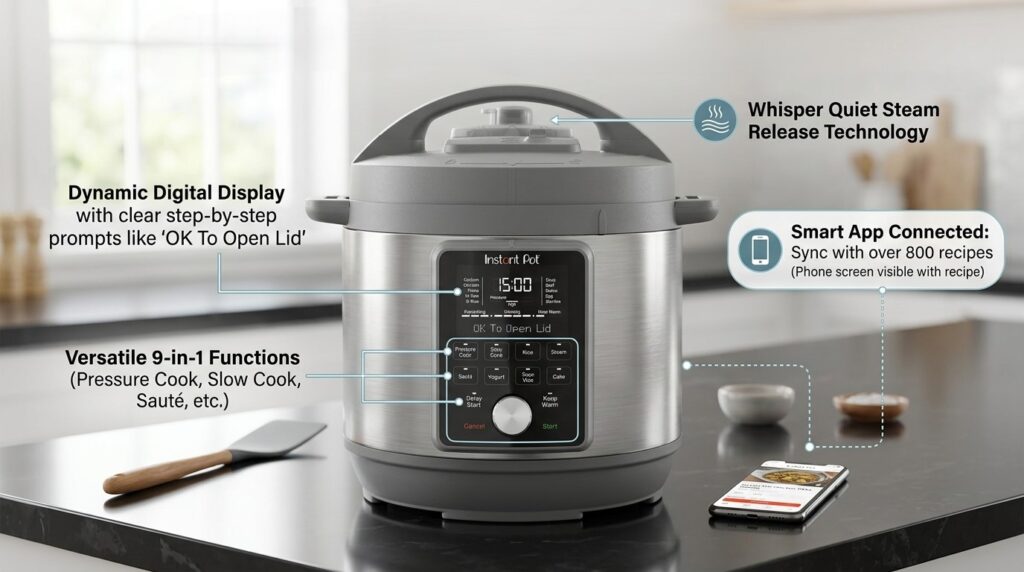
The defining idea behind the Duo Plus line is consolidation. Rather than buying and storing several single-purpose gadgets, the 8-quart Duo Plus is designed to handle a broad range of cooking tasks through one control panel. According to the manufacturer, the unit combines a pressure cooker, slow cooker, rice cooker, steamer, sauté/searing pan, yogurt maker, food warmer, and sterilizer into a single housing, with additional preset programs layered on top for convenience. In practice, this means the same pot that pressure-cooks a batch of chili on Monday can be reprogrammed to slow-cook pulled pork on Wednesday or steam vegetables on Friday, without needing to pull out a different appliance each time.
It’s worth noting that “9-in-1” branding across multi-cookers generally refers to a bundle of related cooking programs and modes rather than nine entirely separate mechanical systems. The core hardware is the pressure-sealed pot and heating element; the functions are largely a matter of software presets and lid configuration (sealed for pressure cooking, unsealed or vented for sautéing and slow cooking).
WhisperQuiet Steam Release
One of the more noticeable updates on the Duo Plus line, compared to earlier Instant Pot generations, is the WhisperQuiet steam release system. Traditional electric pressure cookers are known for a loud, sometimes startling hiss when releasing built-up steam pressure, particularly during a quick or manual release. The Duo Plus is engineered to reduce that noise, which matters more than it might sound like it would if you’re cooking in an apartment, cooking while a baby naps in the next room, or simply prefer a kitchen that doesn’t announce dinner to the whole floor.
The steam release itself is controlled through a single button positioned on top of the unit, intended to make the process of venting pressure more straightforward and less intimidating for people who are newer to pressure cooking.
Stainless Steel Cooking Pot
The inner cooking pot is made from 18/8 stainless steel with what’s described as a tri-ply bottom — layers of stainless steel and an aluminum core sandwiched together for more even heat distribution. This construction is also designed to be “anti-spin,” meaning the pot stays firmly seated in the base while you’re stirring or sautéing, rather than sliding or rotating. Stainless steel is generally considered a durable, non-reactive material for cookware, and unlike some non-stick coatings, it won’t degrade from metal utensils or high-heat searing over time.
Safety Engineering
Because pressure cookers build up internal steam pressure by design, safety mechanisms are a meaningful part of what you’re evaluating in this category, not just a footnote. The Duo Plus is built with more than ten separate safety mechanisms, according to the manufacturer’s specifications, including overheat protection and a lid that locks in place until internal pressure has been safely released. These systems are largely what separate modern electric pressure cookers from older stovetop models, where pressure regulation depended more heavily on the user’s attention.
Companion App and Recipe Access
The unit connects to a companion app that gives users access to a recipe library described as containing more than 800 recipes, along with guided cooking programs that can sync settings to the device for certain functions. For someone who’s unfamiliar with pressure cooking times, liquid ratios, or how long to steam a particular vegetable, this kind of built-in reference can shorten the learning curve considerably. It’s an optional layer, though — the appliance itself operates independently of the app through its physical control panel and preset buttons.
Capacity and Included Accessories
At 8 quarts, this is the larger end of the Duo Plus lineup (which also comes in smaller sizes, most commonly 3-quart and 6-quart versions). The 8-quart size is generally positioned by the manufacturer as suitable for cooking up to roughly eight servings at a time, which makes it a reasonable fit for larger households, batch cooking, or meal prepping for the week ahead.
The unit ships with a stainless steel steam rack that includes handles (useful for lifting food in and out without direct contact with hot surfaces or liquid), along with two extra sealing rings. Having spare sealing rings on hand from day one is a practical detail, since rings are a wear item that eventually need replacing, and many users prefer keeping a separate ring for sweet versus savory cooking to avoid flavor transfer.
The lid and inner pot are both listed as dishwasher-safe, which simplifies cleanup considerably compared to appliances with components that require hand-washing only.
How It Can Be Used
A multi-cooker like this one is really only as useful as the range of tasks you actually put it toward, so it helps to think through concrete use cases rather than just the abstract list of functions.
Weeknight meals under time pressure. Pressure cooking is generally the standout function here, since it can significantly cut down cook times for foods that normally take a long time to become tender — think dried beans, tougher cuts of meat, bone broth, or risotto. A dish that might take two or three hours in a Dutch oven on the stovetop can often be finished in a fraction of that time under pressure, though exact timing varies by recipe and quantity.
Batch cooking and meal prep. The 8-quart capacity in particular lends itself to cooking larger volumes in a single session — a big pot of soup, a full batch of grains for the week, or shredded chicken to portion out for multiple meals. Because the unit can also switch to a “keep warm” setting automatically after cooking, food doesn’t need to be transferred immediately if your schedule doesn’t allow for that.
Rice and other grains. The rice cooker function is designed to handle white rice, brown rice, and other grains with more consistency than trying to eyeball timing on a stovetop, particularly useful if rice or grains are a regular part of your meals.
Yogurt making. The yogurt setting maintains a low, steady temperature over an extended period, which is the environment cultures need to properly set. This is a slower process by nature — typically closer to eight hours or more — but it removes the need for a separate yogurt maker appliance if that’s something you make regularly.
Steaming. Using the included steam rack, the unit can steam vegetables, seafood, dumplings, or eggs without submerging the food directly in water, which tends to preserve texture and nutrients better than boiling.
Sautéing and searing. Before switching to pressure or slow cooking, many recipes call for browning meat or softening aromatics like onions and garlic first. The sauté function allows this step to happen directly in the same pot, rather than dirtying a separate pan, which is a small but meaningful convenience during recipe prep.
Keeping food warm for gatherings. For hosting scenarios — holidays, potlucks, family dinners — the warm function can hold finished food at a safe serving temperature for a period of time, which is useful when guests arrive at staggered times.
Sterilizing. The sterilize function is typically used for things like baby bottles, jars for canning or fermenting, and other kitchen items that benefit from a high-heat cycle for sanitation purposes.
Who It May Be Suitable For
Larger households or families. The 8-quart size is specifically built with bigger batches in mind, so households regularly cooking for four or more people, or families who like leftovers on hand, tend to get more proportional value out of this size than someone cooking primarily for one or two.
People trying to consolidate kitchen appliances. If your countertop or cabinets are already crowded with a slow cooker, rice cooker, and a yogurt maker you rarely use, combining several of those functions into one unit can free up real storage space, provided you’re comfortable with a single point of failure if the appliance is ever out of commission.
Meal preppers and batch cooks. Anyone who sets aside a chunk of time on weekends to prepare food for the week ahead may find the combination of a larger pot and faster pressure cooking genuinely useful for cutting down total prep time.
People newer to pressure cooking. Between the companion app’s recipe guidance, the preset programs, and the extensive built-in safety mechanisms, this kind of appliance is generally considered more approachable for beginners than older stovetop pressure cookers, which required more manual attention to pressure regulation.
Hosts and entertainers. The combination of a larger capacity and a warm-holding function can be handy for people who cook for groups semi-regularly.
On the other hand, a few groups may want to think a bit harder before choosing this specific size and configuration. Someone cooking primarily for one or two people might find an 8-quart pot larger than necessary for daily use — pressure cookers generally need a minimum amount of liquid and food volume to function properly, so very small portions aren’t always practical in a larger pot. Similarly, anyone with genuinely limited counter or storage space might want to measure their available room first, since an 8-quart unit is noticeably larger than the 3- or 6-quart versions in the same product line.
Important Things to Consider
A few practical points are worth sitting with before deciding on this appliance, separate from the feature list itself.
Physical footprint. An 8-quart electric pressure cooker is a substantial appliance — heavier and larger than a 6-quart model, and considerably larger than a standalone rice cooker or slow cooker. If you plan to store it rather than leave it out permanently, it’s worth confirming you have a cabinet or shelf that can comfortably fit it, along with the lid.
Learning curve, even with safety features. While the built-in safety mechanisms are designed to prevent common mishaps, pressure cooking as a method still benefits from following recipe instructions closely, particularly around liquid ratios and release methods (natural release versus quick release). New users may want to start with simpler recipes before attempting more ambitious ones.
The app is a companion, not a requirement. The recipe library and connectivity features are a helpful addition, but the appliance is fully operable through its own control panel without ever connecting to Wi-Fi or a smartphone. If app-based features matter to you, it’s worth checking current compatibility with your phone’s operating system before purchase, since app requirements can shift over time.
Sealing ring odor retention. Silicone sealing rings, which are used across most modern electric pressure cookers, are known to absorb odors from strongly flavored dishes over time. This is why the unit includes two rings out of the box — many users designate one ring for savory cooking and a second for more neutral or sweet applications like yogurt, to reduce flavor crossover.
Not identical to “set it and forget it” slow cooking. While the Duo Plus does include a slow cook function, and the pressure cook function is genuinely faster than most conventional methods, a full pressure cooking cycle does involve time for the pot to come up to pressure and, in many cases, time to naturally release afterward. Total time from start to plated food is often still faster than traditional methods, but it isn’t always instantaneous.
Replacement parts availability. Because this is a widely used product line, replacement sealing rings, inner pots, and accessories are generally available separately, which can extend the appliance’s usable life if a particular part wears out before the rest of the unit.
Comparing General Categories of Cooking Appliances
Rather than comparing this specific product to other individual products, it’s more useful to understand how multi-cookers as a category compare to the alternatives most people are actually choosing between.
Multi-function cookers versus single-purpose appliances. A dedicated slow cooker, a dedicated rice cooker, and a dedicated pressure cooker will each typically be simpler to operate for their one job, since there’s no need to select a mode or program — the appliance does one thing by design. The trade-off is that you need separate appliances for each function, which takes up more storage and counter space, and represents a larger upfront investment across multiple purchases. A multi-cooker consolidates these into one unit and one learning curve, at the cost of needing to share that single appliance across tasks — if it’s tied up making yogurt overnight, for example, it isn’t available for anything else in the meantime.
Pressure cooking versus conventional stovetop or oven cooking. Pressure cooking works by trapping steam to raise the boiling point of liquid inside a sealed pot, which cooks food faster than atmospheric-pressure methods like simmering or braising. This tends to be particularly noticeable with foods that are traditionally slow to cook, such as dried legumes, tougher cuts of meat, or whole grains. Conventional methods, on the other hand, often allow for more visual monitoring and adjustment along the way, since the pot isn’t sealed. Neither approach is universally “better” — they suit different situations, and many people who own a pressure cooker still use stovetop methods for dishes where reduction, browning, or texture control benefits from an open pot.
Capacity tiers within multi-cookers generally. Multi-cookers in this category are commonly sold in a few standard size ranges — smaller units around 3 quarts, mid-size units around 6 quarts, and larger units in the 8-quart range. Smaller units are generally easier to store and better suited to individuals or couples, while larger units are aimed at bigger households, batch cooking, or entertaining. The trade-off is fairly linear: more capacity generally means a larger physical footprint and a higher minimum quantity of food or liquid needed for the pressure cooking function to work properly.
Frequently Asked Questions
Does this model require the companion app to function? No. The app adds access to a recipe library and some guided programs, but the appliance is fully controllable through its physical panel and preset buttons without any app connection.
Is the 8-quart size necessary, or would a smaller version work? That depends mainly on household size and how you plan to use it. The 8-quart size is generally aimed at larger families, batch cooking, or people who like having leftovers on hand. If you’re typically cooking for one or two people, a smaller capacity in the same product line may be a more practical fit, both for cooking volume and for storage space.
Can the inner pot and lid go in the dishwasher? According to the manufacturer, both the inner pot and lid are dishwasher-safe, which simplifies routine cleanup compared to appliances requiring hand-washing.
How is the yogurt-making function different from a dedicated yogurt maker? The principle is similar — maintaining a steady, low temperature over an extended period to support yogurt cultures. The difference is mainly that this function shares the same appliance used for other cooking tasks, rather than requiring a separate dedicated device.
Is pressure cooking safe for someone who hasn’t used a pressure cooker before? Modern electric pressure cookers, including this one, are generally built with multiple layered safety mechanisms specifically because pressure cooking has a different risk profile than open cooking methods. That said, it’s still worth reading the included instructions and following recipe guidance on liquid amounts and release methods, particularly for the first few uses.
What’s included with the unit besides the pot and lid? The listing indicates the appliance comes with a stainless steel steam rack with handles and two additional sealing rings, on top of the main unit itself.
Does the sauté function replace a stovetop pan entirely? Not necessarily for every task, but it does allow browning, searing, or softening ingredients directly in the same pot before switching to pressure or slow cooking, which can reduce the number of dishes used during a single recipe.
Final Thoughts
The Instant Pot Duo Plus 8-Quart sits in a category built around consolidation — folding several separate kitchen appliances into one unit with a shared control panel, a shared cooking pot, and a shared learning curve. Whether that trade-off makes sense for a given kitchen really comes down to household size, how much counter or storage space is available, and how many of those nine functions you’d realistically use on a regular basis versus how many would sit unused.
For larger households, regular meal preppers, or anyone looking to simplify a crowded collection of single-purpose appliances, the combination of pressure cooking, slow cooking, steaming, sautéing, rice cooking, yogurt making, warming, and sterilizing in one stainless steel pot is a fairly comprehensive answer to that need. For smaller households or those with limited kitchen storage, it may be worth comparing this against the smaller-capacity versions in the same line before settling on the 8-quart size specifically.