Introduction
Choosing a coffee maker sounds simple until you actually stand in front of the options. Drip machines, espresso setups, pour-over kits, and single-serve pod brewers all promise the same basic outcome — a hot cup of coffee — but they get there in very different ways, and they fit very different kitchens and routines. The Keurig K-Express Single Serve K-Cup Pod Coffee Maker, offered here in the Warm Stone finish, sits firmly in the single-serve pod category, built around simplicity, a compact footprint, and quick daily use rather than barista-style customization.
This article walks through what the K-Express actually does, how people tend to use machines like it, who it’s likely to fit well, and what’s worth thinking about before deciding whether it belongs on your counter. The goal here isn’t to declare a winner or make sweeping claims — it’s to lay out the practical details so you can weigh them against your own coffee habits.
Key Features of the Keurig K-Express
Three Brew Sizes for Different Cups
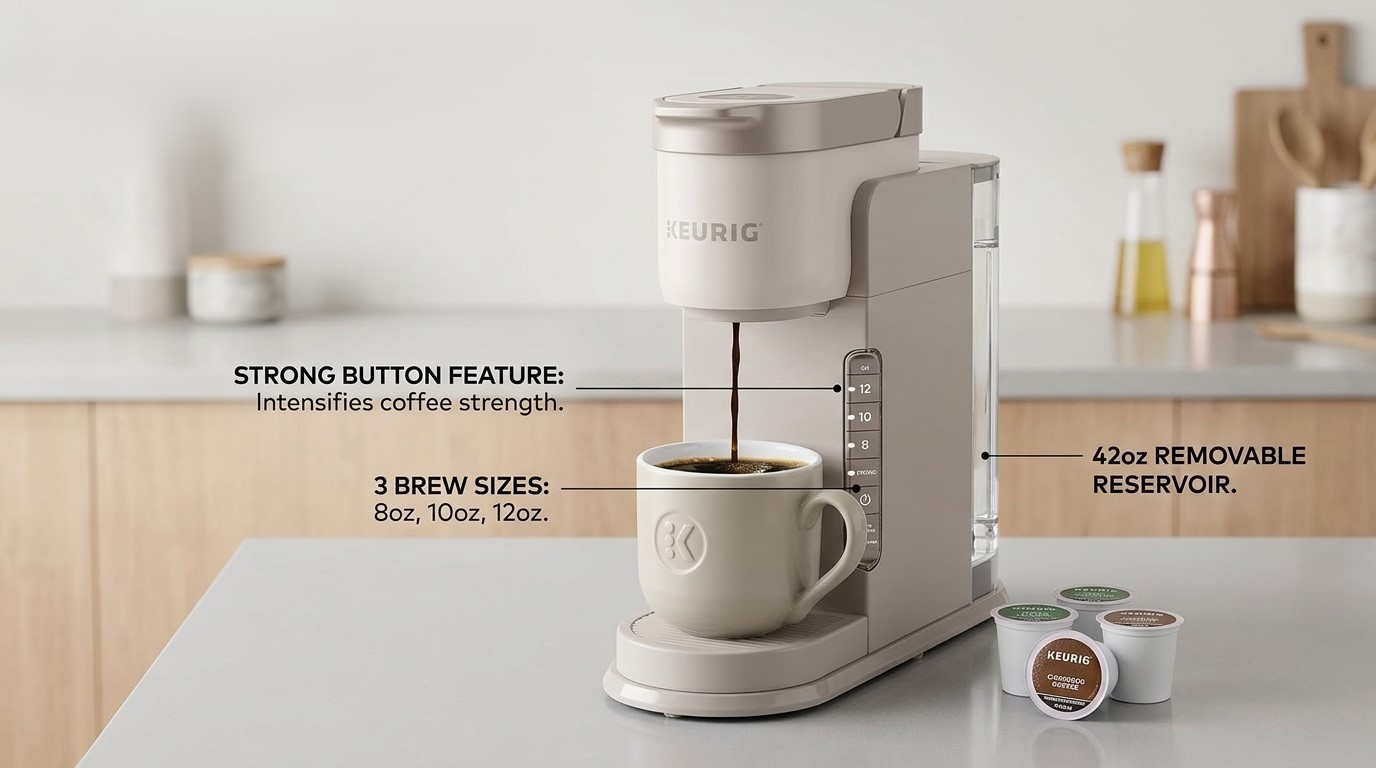
The K-Express brews in three sizes — 8, 10, and 12 ounces — selected with a button rather than a dial or manual pour measurement. That range covers a standard mug, a slightly larger mug, and something closer to a tall cup, which gives a little flexibility without turning the process into a multi-step decision. It’s worth noting this isn’t the wider range you’d find on some higher-tier Keurig models, which can stretch down to smaller espresso-style pours or up toward carafe-sized servings. Here, the sizing is kept intentionally narrow and straightforward.
A Strong Button for Bolder Flavor
Pod coffee has a reputation, fair or not, for brewing on the weaker side compared to a manually measured pour-over or a strong pot of drip coffee. The Strong button is Keurig’s answer to that — it slows the brew cycle down so water spends more time in contact with the grounds inside the pod, which tends to pull out a more concentrated, fuller-bodied cup. It doesn’t change the pod itself, so the ceiling on intensity is still set by whatever K-Cup you’re using, but it does give you a way to nudge a milder roast toward something with more presence.
42-Ounce Removable Reservoir
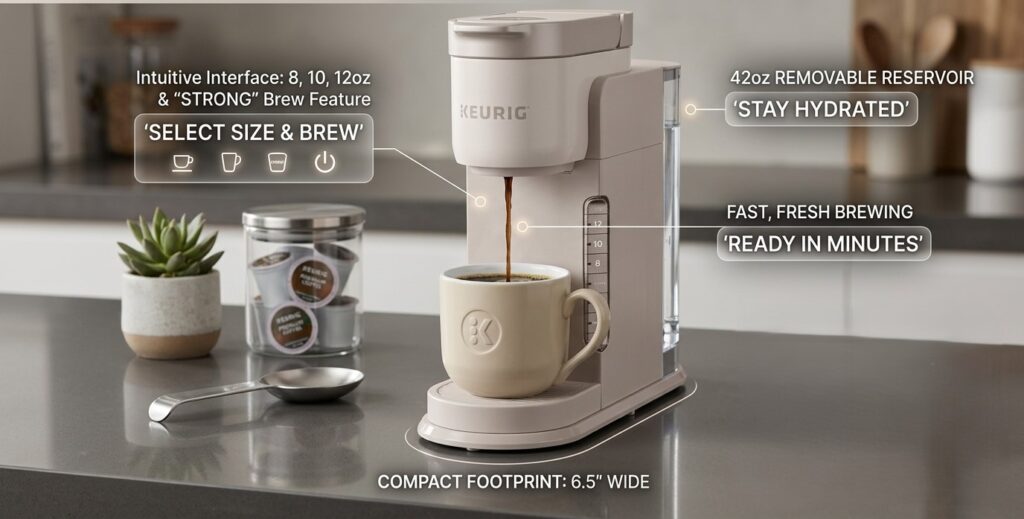
The water reservoir holds 42 ounces and lifts off the base for easy filling at the sink, rather than requiring you to carry the whole machine over or pour water in awkwardly from a pitcher. At that capacity, Keurig notes it’s enough for roughly four 8-ounce brews before a refill is needed, which is a reasonable stretch for a household that isn’t brewing back-to-back all morning. For context, that’s a mid-sized reservoir in the single-serve category — larger than the smallest, most compact Keurig models, but smaller than the higher-capacity machines built for busier households or small offices.
Back-to-Back Brewing Without a Reheat Wait
One detail that matters more in daily use than it might seem on paper: the K-Express doesn’t need to reheat between cups. Once it’s warmed up for the first brew, a second person can pour a cup right after without standing around waiting for the machine to catch back up to temperature. In a two-person household or a small shared office nook, that removes one of the more common points of friction with basic coffee makers.
Compact, Travel-Mug-Friendly Design
At roughly 12.8 inches deep, 5.1 inches wide, and 17.2 inches tall, the footprint is narrow enough to tuck into a corner of most counters, which is part of the appeal for smaller kitchens, apartments, or secondary brewing stations like a home office or guest room. The drip tray is removable, and the space underneath the spout accommodates travel mugs up to about 7.4 inches tall — enough for most standard insulated tumblers, though very tall mugs may still need the tray removed entirely.
Auto Shut-Off for Energy Efficiency
The machine automatically powers down five minutes after the last brew, so there’s no need to remember to switch it off manually before leaving the kitchen. It’s a small feature, but over months of daily use it adds up in terms of both energy use and peace of mind if you’re prone to walking out the door without double-checking appliances.
Reusable Filter Compatibility
While the K-Express is built primarily around K-Cup pods, it’s also compatible with Keurig’s My K-Cup Universal Reusable Coffee Filter, sold separately. That accessory lets you brew your own ground coffee instead of a disposable pod, which opens the door to using coffee you already have on hand, specialty blends that aren’t sold in pod form, or simply cutting down on pod waste for at least some of your daily brewing.
Warm Stone Finish
The Warm Stone colorway leans into a soft, neutral tone that reads more like natural stone or warm greige than a stark white or glossy black. It’s designed to blend into kitchens with earthy, minimalist, or warm-toned color palettes rather than stand out as a bold accent piece — worth keeping in mind if you’re matching it to existing appliances or countertop tones.
How It Can Be Used
The most obvious use case is the one right in the name: brewing a single cup of coffee, quickly, without the setup or cleanup of a full pot. But the practical uses extend a bit further than that.
Morning routines with minimal prep. Because the machine heats water and brews in a matter of minutes, it fits well into routines where time is tight — getting a cup started while getting dressed, packing a bag, or handling the first few emails of the day.
Households with different coffee preferences. Since each brew comes from an individual pod, people sharing a kitchen don’t have to agree on one roast or one strength. One person can brew a dark roast at the Strong setting while someone else brews a flavored or decaf option a few minutes later, without wasting a full pot’s worth of coffee that only partially gets used.
Tea and hot cocoa, not just coffee. K-Cup pods aren’t limited to coffee — plenty of tea and hot cocoa options exist in the same format, so the machine can double as a general hot-beverage station rather than a coffee-only appliance.
Guest-friendly serving. For gatherings where guests have different tastes, a pod-based machine sidesteps the question of brewing multiple pots or guessing at everyone’s preferred strength. Each guest can pick their own pod and size.
Secondary or supplementary brewing. Some households keep a machine like this as a second brewer — for instance, a drip machine for the main household pot and a single-serve unit for late risers, afternoon cups, or a home office where firing up a full pot doesn’t make sense for one cup.
Occasional ground-coffee brewing. With the reusable filter accessory, the K-Express can pull double duty for someone who wants pod convenience most days but the option to brew a favorite bag of ground coffee occasionally, without owning two separate machines.
Who It May Be Suitable For
This kind of machine tends to appeal to a fairly specific set of situations rather than being a universal fit, and it’s worth being honest about that rather than suggesting it works for everyone equally well.
- Individuals or couples who mainly need one or two cups at a time rather than a full pot that risks going stale before it’s finished.
- Small kitchens, apartments, dorm rooms, or offices where counter space is limited and a compact, straightforward machine is more practical than a larger multi-carafe system.
- People who value speed and simplicity over adjusting grind size, ratios, or brew temperature by hand.
- Households with mixed coffee preferences, where everyone drinking a different roast, strength, or beverage type without brewing multiple pots is a real convenience.
- Anyone who already drinks K-Cup pods or is open to trying them, since the machine’s day-to-day cost and convenience are closely tied to pod availability and variety.
- People setting up a secondary brew station, such as a guest room, home office, or a break room in a small workplace.
On the other hand, it’s probably a less natural fit for people who brew large batches for a big household every morning, those who are firmly committed to a specific manual brewing ritual like pour-over or French press, or anyone trying to avoid pod-based coffee altogether for cost or environmental reasons.
Important Things to Consider
No appliance is the right fit for every kitchen, and a few practical trade-offs are worth thinking through before deciding.
Ongoing pod cost versus bulk coffee. K-Cup pods generally cost more per cup than bagged or canned coffee brewed by the pound, since you’re paying partly for the packaging and convenience. Over months and years of daily use, that difference can add up, which is worth weighing against how much the convenience factor matters to you personally.
Environmental considerations. Single-use pods generate more packaging waste than bulk coffee brewing methods. The reusable filter accessory can offset some of this if used regularly, and some K-Cup pods on the market are made to be recyclable, though recycling requirements and local facilities vary, so it’s worth checking labeling if that’s a priority for you.
Capacity limits for larger households. The 42-ounce reservoir and single-serve format work well for one or two people, but a household of four or five brewing coffee back-to-back every morning may find themselves refilling the reservoir and swapping pods more often than they’d like compared to a traditional multi-cup drip machine.
Flavor consistency depends on the pod. Because brewing happens through a pre-portioned pod, the final cup’s flavor is largely determined by the pod manufacturer rather than adjustable variables like grind size or bean origin. The Strong button helps intensify the brew, but it works within the limits of whatever pod is loaded, rather than replacing the kind of control you’d get from a manual brewing method.
No built-in frother or specialty drink features. This is a straightforward hot-water-through-a-pod machine — it doesn’t include milk frothing, iced-brew settings, or espresso-style pressure brewing. Anyone wanting lattes, cold brew, or espresso drinks at home would need separate equipment or accessories for those.
Routine maintenance still applies. Like any coffee maker, periodic descaling is recommended to keep water flow and brew temperature consistent, particularly in areas with hard water. This is a normal part of ownership rather than a flaw specific to this model, but it’s worth factoring into expectations around upkeep.
Comparing General Categories of Home Coffee Makers
It can help to zoom out and think about where single-serve pod machines fit relative to other common home brewing categories, without getting into brand-specific comparisons.
Single-serve pod machines (the category this product belongs to) prioritize speed, portion control, and minimal cleanup. You get one cup at a time, brewed in a few minutes, with little room for manual adjustment. The trade-off is a narrower range of flavor customization and a higher per-cup cost tied to pod pricing.
Traditional drip coffee makers brew a full pot at once using bulk ground coffee, which tends to be more economical per cup and produces more coffee in a single cycle — useful for larger households or anyone who drinks multiple cups over a morning. The trade-off is that a full pot can sit and lose freshness if it isn’t finished promptly, and everyone sharing the pot generally drinks the same brew strength and roast.
Manual methods like pour-over, French press, or AeroPress-style brewers put the most control in the user’s hands — adjusting grind size, water temperature, and steep time to fine-tune flavor. These methods typically take longer and require more hands-on attention and cleanup, which suits people who see coffee brewing as part of the ritual rather than a means to an end.
Espresso machines, whether manual, semi-automatic, or fully automatic, are built around concentrated shots and often milk-based drinks like lattes or cappuccinos. They generally involve a steeper learning curve and higher upfront cost, and they serve a different purpose than a straightforward drip-style cup of coffee.
Positioned against these categories, a machine like the K-Express leans toward convenience and consistency over customization or bulk output — a reasonable fit for anyone whose priority is a fast, no-fuss individual cup rather than a specialty beverage or a full pot to share.
Frequently Asked Questions
Does the K-Express work with any K-Cup pod brand? It’s built for standard K-Cup pods, and there are hundreds of coffee, tea, and hot cocoa options made in that format across many brands, so compatibility is generally broad rather than limited to one specific pod line.
Can it brew coffee without a pod? Yes, but only with the separately sold My K-Cup Universal Reusable Coffee Filter, which lets you load your own ground coffee instead of using a disposable pod.
How many cups can I brew before refilling the water reservoir? Keurig states the 42-ounce reservoir supports around four 8-ounce brews before it needs a refill. Brewing larger 10- or 12-ounce cups will naturally use more water per brew, so the number of cups per fill will be somewhat lower at those sizes.
Does the Strong button change the pod itself? No — it adjusts the brewing process by extending contact time between water and the grounds inside the pod, which produces a more concentrated cup. It works within the flavor profile of whatever pod is used rather than altering the pod’s contents.
Is it suitable for a travel mug? The removable drip tray area accommodates mugs up to about 7.4 inches tall. Taller travel mugs may still fit if the drip tray is removed, though it’s worth measuring your specific mug against that figure first.
Does it need to reheat between each cup? No — one of the practical advantages of this model is that it supports back-to-back brewing without a reheating pause, which is convenient when more than one person wants coffee within a short window of each other.
How much counter space does it need? The unit measures approximately 12.8 inches deep, 5.1 inches wide, and 17.2 inches tall, which is a relatively narrow footprint suited to smaller counters, apartments, dorms, or office setups.
Does it turn off automatically? Yes, an auto shut-off feature powers the machine down five minutes after the last brew cycle, which helps with both energy use and general peace of mind.
Conclusion
The Keurig K-Express Single Serve K-Cup Pod Coffee Maker in Warm Stone is built around a fairly clear set of priorities: quick individual brewing, a compact and neutral-toned design, and enough flexibility in size and strength to cover everyday needs without venturing into specialty territory. It’s not trying to replace an espresso machine or a large drip pot for a full household, and it doesn’t pretend to offer the kind of manual control that pour-over enthusiasts look for. What it does offer is a straightforward, low-maintenance way to get a hot cup of coffee, tea, or cocoa in a few minutes, with the option to brew your own grounds when you want to step outside the pod format.
Whether it’s the right fit really comes down to how you actually drink coffee day to day — how many cups, how many people, and how much you value convenience over customization. Weighing those habits against the features and trade-offs outlined above should make the decision a lot more straightforward.