Introduction
There’s a particular kind of kitchen chaos that happens when you’re feeding a lot of people at once — a holiday gathering, a weekend potluck, a house full of relatives who all showed up hungry at the same time. Standard-sized slow cookers, the ones that hold four to six quarts, tend to buckle under that kind of demand. You end up running two batches, borrowing a neighbor’s cooker, or scaling a recipe down until it barely resembles what you meant to make.
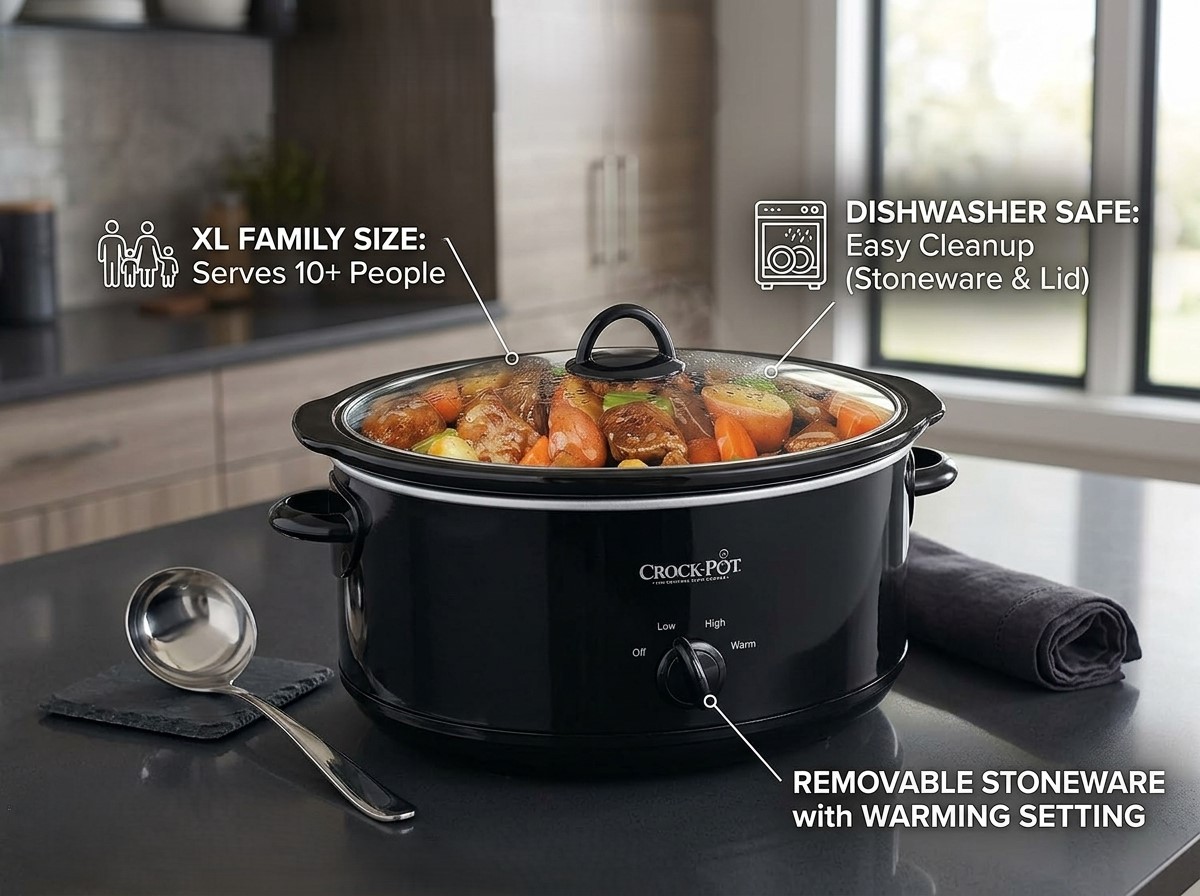
This is where the category of extra-large slow cookers comes in, and the Crock-Pot 8-Quart Manual Slow Cooker is one example built specifically for that gap. With an 8-quart capacity and a stated serving range of ten or more people, it’s designed less for the everyday weeknight dinner and more for the moments when quantity actually matters — big-batch soups, whole roasts, holiday side dishes, or meal prep that needs to last a household all week.
This article walks through what this type of slow cooker generally offers, how people tend to use appliances in this size and style category, who it may or may not be a good fit for, and what’s worth thinking about before adding one to a kitchen that may already have other cooking appliances in it. None of this is meant as a sales pitch — it’s meant to give you the practical context you’d want before deciding whether an appliance like this belongs in your kitchen.
Key Features
Large, Family-Sized Capacity
The defining feature of this model is right there in the name: 8 quarts. To put that in perspective, a standard slow cooker in most households runs somewhere between 4 and 6 quarts, which is generally enough for a family of four to six. An 8-quart unit roughly doubles the space of the smaller end of that range, which is why it’s marketed toward households or gatherings serving ten or more people.
That extra volume isn’t just about fitting more soup. It also allows for cooking larger single items — a whole chicken, a bone-in pork shoulder, a full rack of ribs — that simply wouldn’t fit in a smaller vessel without being cut down first.
Manual, Dial-Based Controls
Unlike programmable slow cookers that come with digital timers, delay-start functions, and app connectivity, this model uses manual controls. Typically, that means a simple dial or switch offering Low, High, and Warm settings. There’s no screen, no programming sequence, and no countdown timer to set.
For some people, that simplicity is exactly the appeal. There’s nothing to learn, nothing that can glitch or reset if the power flickers, and no menu to navigate when your hands are full. For others who prefer walking away for eight hours without checking on food, a manual model requires a bit more attention, since it won’t automatically switch to “keep warm” the moment cooking time is up unless you’re there to change the dial.
Removable Stoneware Insert
The stoneware crock lifts out of the metal housing, which serves a couple of practical purposes. First, it means the cooking vessel itself can go into the dishwasher rather than requiring the entire appliance to be wiped down by hand. Second, a removable insert is generally easier to bring to the table for serving, since you’re not hauling the heating base along with it.
Stoneware itself has a longstanding reputation in slow cooking circles for even, gentle heat distribution, which is part of why the format has remained largely unchanged across decades of slow cooker design.
Warming Setting
Beyond Low and High, the inclusion of a Warm setting is a small but genuinely useful detail. Once food finishes cooking, switching to Warm holds it at a safe serving temperature without continuing to cook it further. This matters for buffet-style meals or potlucks, where food might sit out for an hour or two before everyone’s ready to eat, and you don’t want it drying out or overcooking in the meantime.
Dishwasher-Safe Components
Cleanup is often the deciding factor in whether an appliance gets used regularly or ends up in the back of a cabinet. A dishwasher-safe stoneware insert (and typically the glass lid as well) removes a lot of the friction that comes with hand-washing a large, heavy piece of cookware after a big meal.
Compact-for-Its-Size Design
Despite the large capacity, manufacturers in this category generally aim to keep the footprint as manageable as possible, using an oval or round shape that fits reasonably well on a standard countertop or stores in a lower cabinet. It’s still a large appliance — there’s no getting around the physical reality of 8 quarts — but the design intent is usually to avoid it feeling unwieldy.
How It Can Be Used
An 8-quart slow cooker opens up a wider range of cooking projects than smaller models simply because of the space available. Here are some of the more common ways people put this size and style of appliance to use.
Large-batch soups and stews. Chili, minestrone, chicken noodle soup, beef stew — anything that benefits from long, slow simmering tends to work well here, and the larger capacity means you can make enough to feed a crowd or freeze portions for later without needing to double a recipe across two pots.
Whole roasts and larger cuts of meat. A pork shoulder for pulled pork, a whole chicken, a beef brisket, or a leg of lamb can often fit whole into an 8-quart cooker in a way that just isn’t possible in a 5 or 6-quart model. This is particularly relevant around holidays, when a turkey breast or a large ham might otherwise monopolize oven space.
Holiday side dishes. Slow cookers are frequently used to free up stovetop and oven space during big meals. Mashed potatoes, stuffing, baked beans, and mac and cheese can all be prepared in a slow cooker and then switched to Warm, which keeps the oven and stovetop open for the dishes that actually require them.
Batch cooking and meal prep. For households trying to prepare a week’s worth of meals in one sitting, the extra capacity means fewer rounds of cooking. A large batch of shredded chicken, pulled pork, or a big pot of grains and beans can be portioned out across several days.
Entertaining and potlucks. Because the stoneware insert is removable and the Warm setting keeps food at serving temperature, this type of cooker often ends up doing double duty as a serving dish at parties, buffets, or potluck-style gatherings.
Dips and party foods. On a smaller scale, an 8-quart cooker can also handle warm dips, like queso or spinach artichoke dip, for large gatherings — though for very small quantities, a mini slow cooker might actually be more practical.
Who It May Be Suitable For
Not every household needs an appliance this size, and it’s worth being honest about who tends to get the most out of one.
Larger families. Households with four or more people, especially those that include growing kids or multiple adults with big appetites, often find that standard-sized slow cookers run out of room quickly. An 8-quart model gives more breathing room for both quantity and larger cuts of meat.
People who host regularly. If your home tends to be the gathering spot for holidays, game nights, or extended family visits, having a cooker that can handle a crowd without needing to double a recipe is a practical convenience.
Batch cooking and meal-prep enthusiasts. For people who like to cook once and eat for several days, the extra volume means fewer cooking sessions are needed to stock a fridge or freezer.
Anyone who prefers simple, straightforward appliances. Because this is a manual model rather than a programmable one, it tends to suit people who don’t necessarily want or need digital timers and presets — just a dial, a pot, and a lid.
On the other hand, this may not be the right fit for everyone. Individuals or couples cooking primarily for one or two people will likely find an 8-quart cooker larger than necessary for daily use, and may be better served by a smaller model reserved for occasional big-batch cooking. Similarly, anyone with very limited counter or storage space should factor in the physical size before purchasing, since an appliance this large needs a dedicated spot to live when it’s not in use.
Important Things to Consider
Before adding a large manual slow cooker to your kitchen, a few practical points are worth thinking through.
Counter and storage space. An 8-quart slow cooker is a genuinely large appliance. Before buying one, it’s worth measuring the space where you’d store it — whether that’s a cabinet, a pantry shelf, or a permanent spot on the counter — to make sure it will actually fit alongside everything else you own.
Manual vs. programmable controls. Because this model doesn’t include a timer or auto-shutoff, it generally requires someone to be around to switch it to Warm once cooking is finished, or at least to plan the cooking window around when people will be home. If you regularly leave the house for long stretches and want food to automatically hold at a safe temperature without supervision, a programmable model might suit your routine better.
Weight when full. A stoneware insert filled with 8 quarts of food is heavy — often in the range of 15 to 20 pounds or more once loaded. Lifting it in and out of the base, or carrying it to a table, is worth keeping in mind, particularly for anyone with wrist, back, or grip concerns.
Recipe scaling. Not every recipe scales up cleanly. Liquid ratios, seasoning levels, and cooking times may need slight adjustments when moving from a 6-quart recipe to an 8-quart batch, since a fuller pot behaves a little differently than a partially filled one. It can help to look for recipes written specifically with larger slow cookers in mind, or to adjust gradually the first few times you use it.
Household size versus actual need. It’s worth being realistic about how often you’ll actually cook for ten or more people. If that’s a rare occurrence rather than a regular one, you might weigh whether a mid-sized 6-quart cooker — which still handles moderate batches reasonably well — makes more sense for everyday use, with the 8-quart option reserved for those who consistently cook in volume.
Energy and cooking time. Larger volumes of food generally take longer to reach a safe cooking temperature and to fully cook through, which is worth factoring into meal timing, especially for larger cuts of meat where food safety depends on the center reaching an appropriate internal temperature.
Comparison of General Categories
Rather than comparing this specific product against other individual products, it’s useful to understand where it sits within the broader landscape of slow cooker types. This can help clarify whether this size and style fits your actual cooking habits.
By Size
- Mini slow cookers (1–2 quarts): Best suited for dips, sauces, or small households cooking for one. Too small for main meals in most cases.
- Standard slow cookers (4–6 quarts): The most common size for everyday family cooking, generally suitable for two to six people depending on the recipe.
- Extra-large slow cookers (7–8+ quarts): Designed for bigger households, entertaining, or batch cooking. This is the category the 8-quart model falls into, and it trades some counter space and storage convenience for significantly more cooking capacity.
By Control Type
- Manual (dial-based) models: Offer Low, High, and Warm settings through a simple switch. Straightforward to use, typically less expensive, and generally considered reliable since there’s less electronic complexity involved.
- Programmable (digital) models: Include timers, delay-start options, and automatic switching to Warm once the set cooking time elapses. These suit people who want to leave food cooking unattended for a precise window, though they usually cost more and involve slightly more of a learning curve.
- Smart/Wi-Fi-enabled models: Allow remote monitoring or control via a smartphone app. These represent the higher end of the category, useful for people who want to adjust settings without being physically near the appliance.
By Shape
- Round slow cookers: Tend to suit soups, stews, and dips well, since the shape distributes heat evenly around a liquid-heavy dish.
- Oval slow cookers: Generally better suited to larger or longer cuts of meat, like roasts or whole poultry, since the elongated shape accommodates their size more naturally.
Understanding these general categories can help frame where this particular model fits: it’s a large-capacity, manually controlled, round unit — a straightforward tool aimed at people who need volume more than they need built-in automation.
Frequently Asked Questions
Is an 8-quart slow cooker too big for a small household? For a household of one or two people cooking daily meals, an 8-quart cooker is likely more capacity than necessary for routine use. It can still be useful occasionally, for example when batch cooking to freeze portions, but a smaller model may serve everyday needs more efficiently.
Can the stoneware insert go into the oven or under the broiler? Generally, slow cooker stoneware inserts are designed for slow cooker use and are not intended for oven, stovetop, microwave, or broiler use unless the manufacturer specifically states otherwise. It’s best to check the manufacturer’s care instructions before using the insert anywhere other than inside the slow cooker itself.
How long does food typically take to cook in a slow cooker this size? Cooking times vary by recipe, but as a general rule, slow cooker recipes are often written for roughly 6 to 8 hours on Low or 3 to 4 hours on High. Larger quantities of food, as you’d typically cook in an 8-quart unit, may run toward the longer end of that range, and it’s worth using a food thermometer for larger cuts of meat to confirm they’ve reached a safe internal temperature.
Does the Warm setting cook food further? The Warm setting is designed to hold already-cooked food at a safe serving temperature rather than continuing to cook it. It’s meant for keeping meals ready to serve over an extended period, such as during a party or potluck, without drying food out from continued cooking.
Is a manual slow cooker less reliable than a programmable one? Not inherently — manual and programmable models both use the same basic slow-cooking principle. The main difference is convenience features. A manual model requires someone to switch it off or to Warm at the right time, while a programmable model can do that automatically. Reliability in terms of even cooking generally comes down to the quality of the stoneware and heating element rather than whether it has a digital display.
Can this type of slow cooker replace an oven for large gatherings? It can supplement oven space rather than fully replace it. Many people use a large slow cooker to prepare a main dish or side dish separately, freeing up the oven for items that specifically need roasting or baking. It’s a practical way to manage limited oven space during holidays or large meals, even if it doesn’t take over every cooking task.
What’s the best way to clean it after a big meal? Since the stoneware insert is generally removable and dishwasher safe, cleanup typically involves lifting it out and either hand-washing or placing it in the dishwasher, while the heating base itself (which shouldn’t be submerged in water) is wiped down separately with a damp cloth.
Does size affect how evenly food cooks? Larger slow cookers are designed to distribute heat across their full capacity, but as with any cooking vessel, it’s a good idea to avoid drastically underfilling a large cooker with a small amount of food, since that can affect cooking consistency. Most manufacturers recommend filling the insert at least partway to get the best results.
Conclusion
An 8-quart manual slow cooker occupies a specific and useful niche in the world of kitchen appliances. It’s not designed to be an everyday tool for a household of two — it’s built for the moments when you’re cooking in volume, whether that’s a holiday side dish, a big pot of chili for a crowd, or a week’s worth of meal-prepped protein. The manual controls keep things simple, the removable stoneware makes cleanup easier, and the Warm setting adds a practical bit of flexibility for entertaining.
Like any appliance, whether it’s the right choice comes down to how it fits your actual cooking habits, your available storage space, and how often you find yourself needing to feed a larger group. For households or cooks who regularly run into that need, a large-capacity slow cooker like this one can take a genuine burden off oven and stovetop space during busy meals.