Introduction
Choosing a coffee maker for a household is a surprisingly personal decision. Some people brew a single mug before heading out the door, while others need a full pot ready for a family, a shared office kitchen, or a weekend of guests. The Cuisinart DCC-3200, part of the brand’s PerfecTemp lineup, is built around that second scenario — a programmable drip machine with a 14-cup glass carafe, a stainless steel housing, and a set of controls designed to give the person brewing a bit more say over strength, timing, and portion size.
This article walks through what the DCC-3200 actually offers, how the various settings function in day-to-day use, who tends to get the most out of a machine like this, and a few practical things worth thinking through before adding one to a kitchen counter. Rather than framing this as a verdict on whether the machine is “good” or “bad,” the goal here is to lay out the information clearly enough that you can decide for yourself whether it fits the way you actually make and drink coffee.
Key Features
Programmable Brewing, Up to 24 Hours Ahead
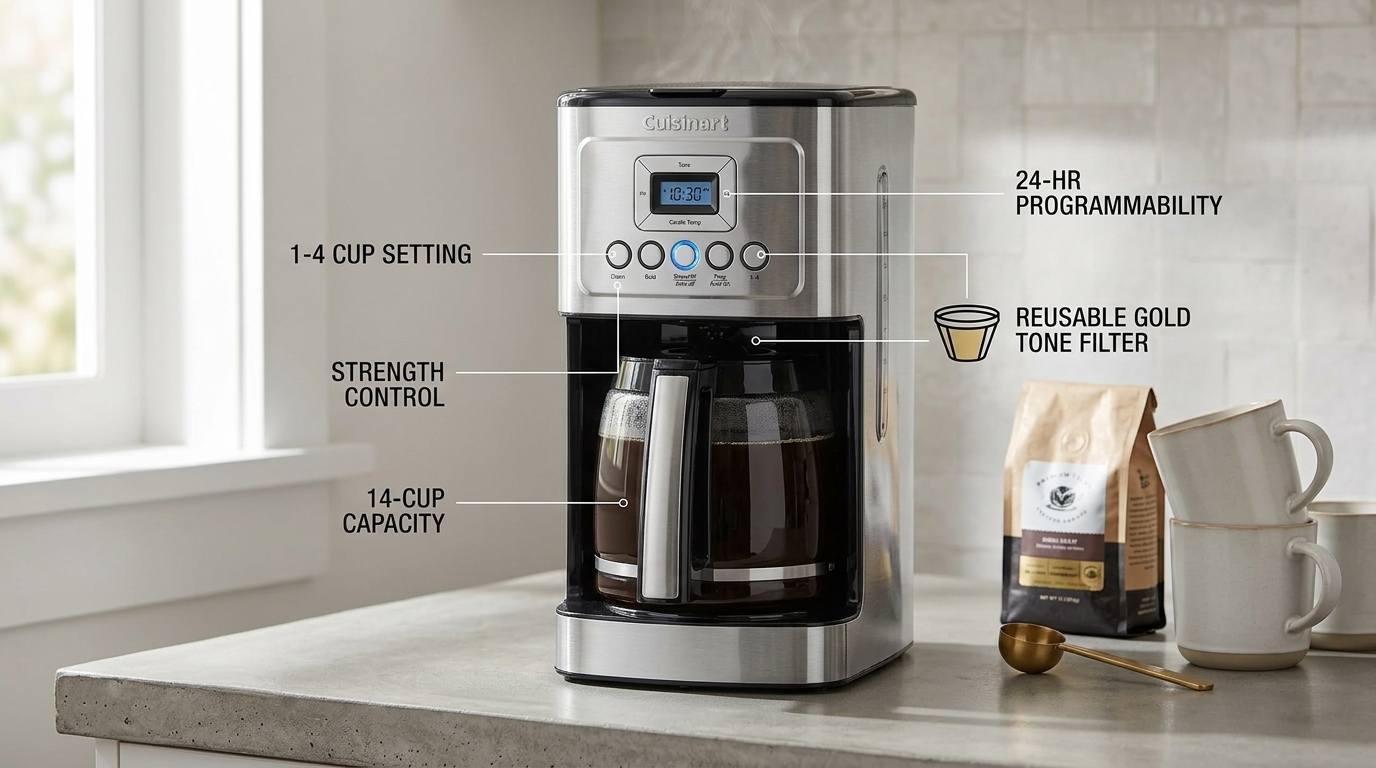
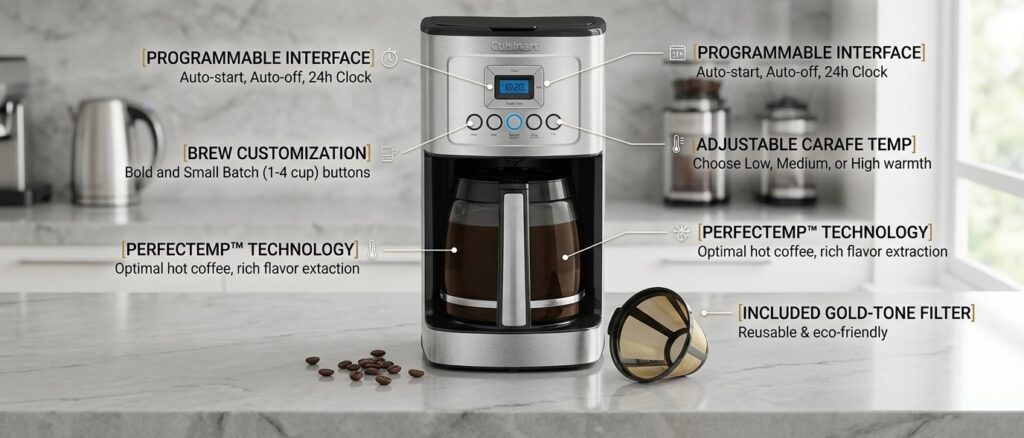
One of the defining features of the DCC-3200 is its programmability. The clock and brew-start function allow the timer to be set as much as a full day in advance, which means the machine can be prepped the night before — or even earlier in the week — and left to start on its own the next morning. For anyone who values not fumbling with buttons before their first cup of coffee, this kind of lead time is a meaningful convenience.
14-Cup Glass Carafe with a Stainless Steel Frame
The carafe holds up to 14 cups, which in most manufacturer terminology refers to 5-ounce servings rather than a standard 8-ounce mug, so it’s worth mentally converting that to roughly eight to nine regular-sized mugs of coffee per full brew. The carafe itself is glass, fitted with a stainless steel handle, and paired with a stainless steel-accented housing that gives the machine a more finished look on a counter compared to an all-plastic body.
1–4 Cup Setting for Smaller Batches
Not every brew needs to fill the whole carafe. The DCC-3200 includes a dedicated setting for smaller quantities — roughly one to four cups — which adjusts the brewing cycle so that a partial pot doesn’t come out weak or under-extracted the way it sometimes does on machines built only for full-pot brewing. This is a small but genuinely useful detail for single-person households or anyone brewing outside of peak morning hours.
Brew Strength Control
A dedicated strength control lets you choose between a regular flavor profile and a bolder one. In practical terms, selecting the bold setting slows the water flow slightly, giving the grounds more contact time and pulling out a more concentrated cup without needing to change how much coffee you scoop in. It’s a simple way to adjust taste without guessing at ratios.
PerfecTemp Technology
The “PerfecTemp” name refers to Cuisinart’s approach to brewing and holding coffee at a warmer temperature than many standard drip machines, while aiming to preserve flavor rather than just cranking up the heat. The warming plate underneath the carafe also has adjustable heat settings, so the coffee can be kept at a preferred temperature after brewing finishes rather than defaulting to a single fixed setting.
Reusable Gold-Tone Filter
Instead of relying solely on paper filters, the machine comes with a permanent gold-tone filter that fits into the filter basket. This is a mesh-style filter designed to be rinsed and reused, which cuts down on the ongoing cost and waste of paper filters. The basket is also compatible with standard #4 paper filters for anyone who prefers that method, so the choice is left up to the user rather than locked into one system.
Charcoal Water Filter
A small charcoal filter is included and sits in the water reservoir, intended to reduce chlorine taste and odor from tap water before it reaches the coffee grounds. Cuisinart recommends replacing it periodically — general guidance points to roughly every sixty days or sixty brew cycles, with more frequent changes suggested for households on harder water.
Backlit LCD Display and Control Panel
The control panel includes a backlit display that shows the programmed time, brew status, and settings. Because the display is illuminated, it stays legible in a dim kitchen during early morning hours, which is a small but appreciated detail for a machine that’s often used before anyone’s fully awake.
Auto Shutoff and 60-Second Memory Reset
For safety and energy use, the machine automatically powers off after a set period — adjustable up to about four hours after brewing completes. There’s also a short-term memory function that retains programmed settings for roughly sixty seconds in the event of a brief power interruption, so a quick flicker in the electricity doesn’t necessarily mean reprogramming the whole unit from scratch.
Brew Pause Function
If a cup is needed before the full pot finishes brewing, the machine is designed to allow the carafe to be pulled out briefly without dripping coffee onto the warming plate. This is a fairly standard feature across mid-range drip machines at this point, but it’s worth mentioning for anyone who’s used a coffee maker without it and dealt with the mess that results.
How It Can Be Used
The most obvious use case is straightforward: fill the reservoir, add ground coffee to the filter basket, choose a strength setting, and either brew immediately or set the timer for later. But there are a few ways the flexibility of the machine opens up beyond that basic routine.
Morning routines with minimal hands-on time. Because the brew-start timer can be set well in advance, some people load the machine the night before, program it for their usual wake-up time, and simply pour a cup once they’re up rather than waiting on the counter for it to finish.
Smaller households or single servings. The 1–4 cup setting means the machine doesn’t have to be reserved for full-pot situations. Someone living alone, or brewing a smaller batch on a lazy weekend, can use this setting to avoid ending up with more coffee than they’ll actually drink while it’s fresh.
Entertaining or multi-person mornings. On the other end, the full 14-cup capacity is suited to situations where more than one or two people need coffee around the same time — a houseful of holiday guests, a small office break room, or a weekend brunch.
Adjusting to different coffee preferences within one household. Because the strength control is adjustable per brew rather than fixed, two people with different taste preferences can still use the same machine on different days without needing to change the amount of coffee grounds each time.
Reducing reliance on paper filters. For anyone trying to cut down on single-use kitchen waste, brewing with the reusable gold-tone filter instead of paper filters is a simple habit change that this machine supports without requiring an aftermarket accessory.
Keeping coffee warm during a slower morning. The adjustable warming plate can be useful for households where not everyone drinks their coffee at the same time — someone getting ready earlier can pour a cup, and the plate keeps the rest at a chosen temperature until the next person is ready.
Who It May Be Suitable For
A machine like the DCC-3200 tends to appeal to a fairly specific set of situations, and it’s worth being honest about who it fits well and who might want to look elsewhere.
- Households that regularly drink more than one or two cups a day. The larger carafe capacity is most useful when there’s consistent demand for multiple servings — otherwise a smaller machine might make more sense.
- People who like to plan ahead. If waking up to a already-brewed pot matters to you, the 24-hour programmability is one of the more useful features here.
- Anyone who wants some control over strength without a lot of manual adjustment. The built-in strength setting removes some of the guesswork involved in getting a bolder cup.
- People who prefer a countertop appliance with a classic drip-brew result rather than single-serve pods or manual brewing methods that require more attention during the process.
- Those looking to reduce paper filter use but who still want the option available for days they’d rather not deal with rinsing a permanent filter.
On the other hand, someone who only drinks coffee occasionally, lives alone and prefers a single mug at a time, or wants the more hands-on ritual of a pour-over or French press might find a smaller or more manual brewing method better suited to their habits.
Important Things to Consider
No coffee maker fits every kitchen or every routine, so a few practical points are worth weighing before deciding if this is the right fit.
Counter space and dimensions. At roughly 14 inches tall, 9 inches wide, and 7.75 inches deep, this is a mid-sized appliance rather than a compact one. It’s worth measuring the intended spot on a counter, particularly under upper cabinets, before assuming it will fit comfortably.
Maintenance routine. Between the reusable gold-tone filter, the charcoal water filter that needs periodic replacement, and general descaling to manage mineral buildup from tap water, this machine does ask for a bit of regular upkeep. Skipping maintenance for long stretches can affect both brewing time and flavor, so it helps to build a light cleaning habit rather than waiting for a problem to show up.
Cup size assumptions. The “14-cup” capacity is based on 5-ounce servings, a fairly standard convention in the drip coffee maker category but one that can be misleading if you’re picturing 14 full mugs. Thinking of it as roughly 8 to 9 standard mugs per full brew is a more realistic expectation.
Noise during brewing. Like many drip machines with a boiling element, this model produces audible sound while heating and brewing — something to keep in mind if it will be programmed to start early in the morning in a home where others are still sleeping nearby.
Warming plate versus thermal carafe. This model uses a glass carafe with a heated warming plate rather than an insulated thermal carafe. That means coffee left on the plate for a long stretch may continue to reduce slightly in flavor quality over time, which is a normal characteristic of warming-plate systems rather than a defect specific to this machine. Anyone who typically nurses a single pot over several hours might prefer a thermal carafe design instead.
Power and electrical needs. As with most higher-capacity coffee makers, this unit draws meaningful wattage during the brew cycle, so it’s worth being mindful of what else is running on the same circuit, particularly in older homes.
How This Type of Coffee Maker Compares to Other Brewing Categories
Rather than comparing this specific model against other branded products, it’s more useful to look at how a machine in this general category — a large-capacity, programmable drip coffee maker — stacks up against a few other common brewing approaches.
Programmable drip machines versus single-serve pod machines. Pod-based machines tend to offer more convenience for one cup at a time and less cleanup, but they generally come with a higher ongoing cost per cup and more packaging waste. A programmable drip machine like this one usually costs less per cup over time and scales better for multiple people, though it asks for a bit more hands-on prep — measuring grounds, filling the reservoir — compared to inserting a pod.
Programmable drip machines versus manual methods (pour-over, French press). Manual brewing methods often give more direct control over extraction and can produce a different flavor profile that some coffee drinkers prefer, but they require active attention throughout the process and aren’t practical for brewing while getting ready for the day. A programmable machine trades some of that manual control for consistency and hands-off convenience.
Programmable drip machines versus espresso or capsule-based machines. Espresso-style machines are built around a very different brewing method entirely, typically producing smaller, more concentrated servings rather than a full carafe. They can also involve a steeper learning curve and, in many cases, a higher upfront cost. A drip machine like this one is generally simpler to operate and better suited to brewing larger quantities of standard coffee rather than espresso-based drinks.
Large-capacity machines versus compact/personal coffee makers. Compact machines are easier to store and often less expensive, but they can be limiting for households with more than one coffee drinker or for entertaining. A 14-cup machine offers more flexibility for volume at the cost of a larger footprint on the counter.
None of these categories is inherently better across the board — the right choice depends mostly on how many people are drinking coffee, how much control over the brewing process matters to you, and how much counter space and budget you’re working with.
Frequently Asked Questions
How many actual mugs of coffee does a full 14-cup brew make? Since the “cup” measurement on most drip coffee makers, including this one, is based on a 5-ounce serving rather than a standard mug, a full pot generally works out to somewhere around 8 to 9 regular 8-to-12-ounce mugs.
Can this machine brew a smaller amount without wasting coffee or water? Yes. The 1–4 cup setting adjusts the brew cycle specifically for smaller batches so the result isn’t unusually weak, which is a common issue on machines that only optimize for a full pot.
Does it need paper filters to work? No. It comes with a reusable gold-tone filter designed to be rinsed and used repeatedly, though the filter basket is also sized to accept standard #4 paper filters if that’s preferred.
How often does the charcoal water filter need to be replaced? General guidance suggests roughly every 60 days or after about 60 brew cycles, with more frequent replacement recommended in areas with harder tap water.
What happens if the power goes out while it’s programmed to brew later? The machine includes a short memory function, generally around 60 seconds, that can retain programmed settings through a brief interruption. A longer outage would likely require reprogramming the timer.
Can I pour a cup before the brewing cycle finishes? Yes, this is the brew pause feature. Removing the carafe briefly during brewing is designed to pause the drip so coffee doesn’t spill onto the warming plate, though it’s generally best not to leave it out for too long, since brewing continues in the background.
Does the coffee stay hot after brewing finishes? The warming plate keeps the carafe at an adjustable temperature after brewing, but auto shutoff will eventually turn the machine off, generally within a few hours depending on how it’s set. Coffee sitting on a warming plate for an extended period will also gradually change in flavor, which is typical of this brewing style rather than something specific to this model.
Is descaling necessary, and how often? As with any machine that heats water repeatedly, mineral buildup from tap water can accumulate over time and affect performance. Periodic descaling, along with rinsing the reusable filter regularly, helps maintain consistent brewing and flavor.
Conclusion
The Cuisinart DCC-3200 fits a fairly common but specific need: a full-size, programmable drip coffee maker for households that regularly brew more than a single cup and want some flexibility around timing, strength, and batch size. Its combination of a 24-hour programmable timer, adjustable strength control, a smaller-batch setting, and a reusable filter gives it a reasonable amount of versatility for a countertop drip machine, while the stainless steel accents and glass carafe keep it in line with what most people expect from this category of appliance.
Like any coffee maker, it comes with trade-offs — a warming plate rather than a thermal carafe, a moderate footprint, and the kind of routine maintenance that any machine handling hard water and daily use will eventually need. Weighing those points against your own coffee habits, kitchen space, and how many people you’re typically brewing for should make it fairly clear whether this style of machine is the right fit.